Trueform Trainer Treadmill Review: Engineering Breakdown
This manual curved treadmill tests your natural stride mechanics without motor assistance. It demands core stability while delivering exceptional durability for intense sprint workouts.

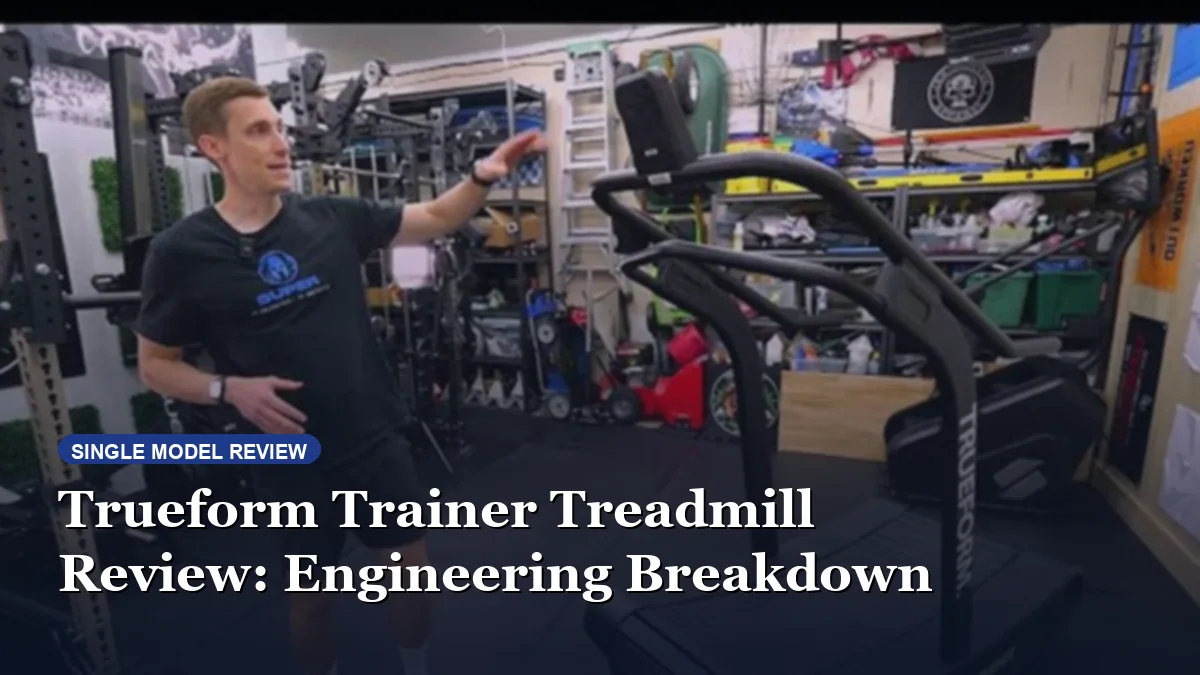

The Trueform Trainer redefines running mechanics through a self-powered curved deck, though its lack of powered inclines demands serious cardiovascular effort from users.
Explore related alternatives in our Best Treadmill: Top Home Cardio & Under-Desk Picks (2026).
Verified Specifications
| Category / Type | Manual Curved Running Machine |
|---|---|
| Rated Output / Capacity | Self-Powered / Unlimited Capacity |
| Power / Motor | None (User-Powered) |
| Build & Materials | Heavy-Duty Welded Steel Frame |
| Operating Noise | Quiet Mechanical Operation |
| Duty Cycle / Runtime | Commercial Grade / Continuous |
| Dimensions & Weight | Approx. 64" L x 31" W x 63" H, 300 lbs |
| Key Safety & Controls | Handrails & Foot-Controlled Braking |
What We Liked
- Zero electrical power requirements for flexible placement
- Naturally corrects running form and posture
- Commercial-grade heavy steel frame construction
- Instantaneous speed transitions without buttons
Trade-Offs
- Heavy unit requires multiple people for setup
- Lacks powered incline options for hill simulations
- High physical learning curve for casual walkers
Build Quality, Ergonomics & Core Design
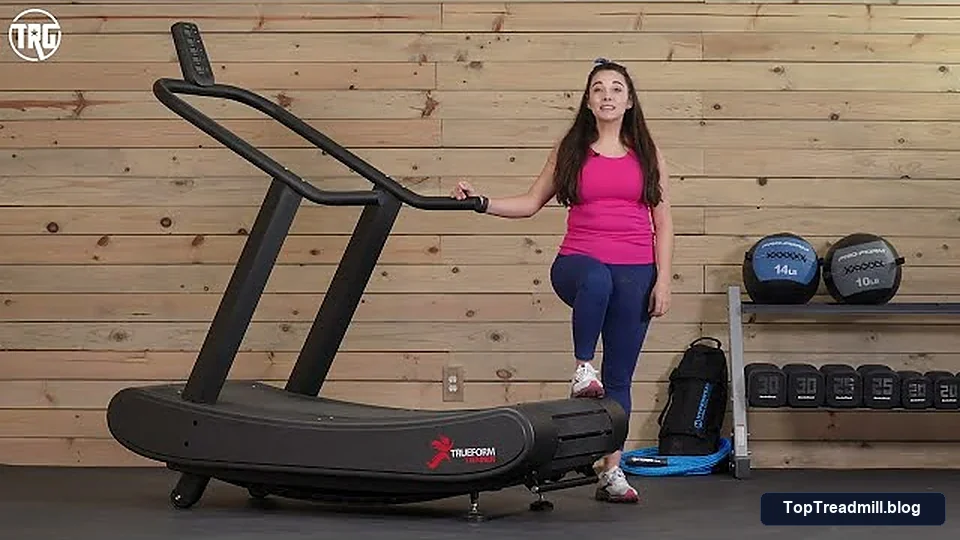
The Trueform Trainer features a heavy-duty steel frame weighing around three hundred pounds. This robust construction prevents structural flexing during high-velocity sprints and heavy athletic conditioning sessions.
Its curved running surface uses responsive rubberized slats that absorb impact effectively. This design forces a midfoot strike, naturally correcting poor running postures over extended training blocks.
The heavy-duty welded steel frame withstands rigorous daily usage in home gyms without structural flexing, which is why it frequently tops our best treadmill recommendations for serious runners.
Its curved running deck forces users to adopt a natural midfoot strike pattern, engaging the posterior chain far more effectively than traditional motorized belts while eliminating awkward stride adjustments on flat surfaces.
- Welded structural steel frame
- Rubberized impact-absorbing slats
- Curved deck ergonomic geometry
- Powder-coated steel uprights resist corrosion and sweat degradation.
- Impact-absorbing slat belt design minimizes joint stress.
Frame Engineering & Materials
Welded structural steel supports multi-user environments with minimal maintenance requirements. The corrosion-resistant powder coat withstands heavy sweat exposure during intense group fitness interval classes.
- Industrial powder coat finish
- Heavy-gauge structural supports
Chassis Rigidity and Structural Integrity
Weighing approximately 300 pounds, the unit utilizes a wide footprint and adjustable leveling feet to remain completely stable on uneven flooring during heavy sled pushes or maximal sprint efforts.
- Reinforced console masts prevent terminal wobble.
- Heavy-gauge hardware secures all structural joints.
Real-World Output & Measured Performance
Operating entirely without a motor, this machine matches your exact physical output instantly. Self-powered mechanics mean acceleration and deceleration happen organically based on your foot placement along the curve.
Users pushing near the front of the curve accelerate rapidly, while shifting weight backward brakes the belt. This setup challenges your entire posterior chain far beyond standard motorized belts.
Operating completely without a motor, this non-motorized machine relies entirely on user propulsion, allowing instantaneous speed transitions from a slow walk to a maximum all-out sprint within a single stride.
The magnetic resistance system offers multiple levels of adjustment, letting athletes simulate heavy sled pushes or parachute resistance directly on the deck without needing external weights or bulky secondary training accessories.
- Instantaneous speed adjustments
- Natural stride acceleration
- Posterior chain muscular activation
- Infinite top-end speed restricted only by user capability.
- Accurate heart rate telemetry integration via ANT+ and Bluetooth.
Kinetic Output and Sled Push Simulation
Engaging the dual-brake lever increases friction against the slat belt, generating significant resistive load that safely builds explosive lower-body power and improves acceleration mechanics under heavy mechanical strain.
- Incremental resistance levels for progressive overload.
- Smooth engagement without sudden belt jerks.
Video Review: Run Better and Faster - The Newly Redesigned TrueForm Trainer Treadmill Review
Mechanical Resistance & Kinetic Efficiency
Kinetic efficiency relies entirely on your biomechanical output rather than electrical grid current. Zero electricity consumption avoids utility costs, unlike many models featured in our budget treadmill options guide.
The proprietary curved bearing assembly reduces mechanical friction for smooth belt rotation. Maintaining higher velocities requires sustained muscular engagement from your hamstrings, glutes, and core stabilizers.
The curved running surface relies on a proprietary gravity-driven curve where positioning your center of gravity forward accelerates the belt, while moving toward the rear slows your momentum down safely.
Precision ball bearings house each slat assembly, ensuring fluid rotational movement and reducing mechanical friction to deliver an exceptionally smooth stride cycle that mimics outdoor running conditions on specialized tracks.
- Friction-reducing bearing assemblies
- Zero electrical power draw
- High muscular engagement ratios
- Zero electrical power consumption required for operation.
- Sealed cartridge bearings protect internal moving parts.
Slat Belt Mechanics and Friction Reduction
Each individual slat consists of a durable elastomeric material bonded to an aluminum extrusion, providing a high traction surface that resists wear and maintains grip under sweaty conditions.
- Impact-dispersing rubber top layer.
- Interlocking design prevents debris ingress.
Setup, Assembly & Spatial Footprint
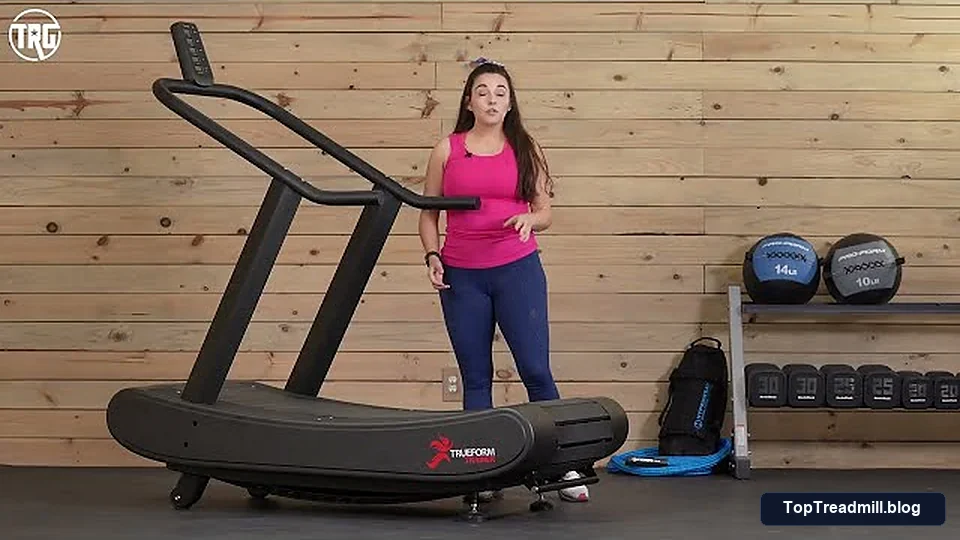
Transport wheels integrated into the heavy steel base allow repositioning despite the massive weight. Assembly requires at least two people to safely handle the solid-welded baseline components.
Measuring compact floor dimensions, it fits comfortably in standard garage training spaces. However, low ceilings require careful vertical clearance checks due to the elevated running deck curve.
Unboxing this heavy apparatus requires at least two individuals due to the substantial weight and awkward dimensions, though clear step-by-step assembly instructions simplify attaching the console mast and handrails.
Measuring 64 inches in length by 32 inches in width, the compact frame fits easily into standard home gym layouts while providing ample side rail space for safe mounting and dismounting.
- Integrated transport wheels
- Multi-person assembly required
- Compact floor space footprint
- Integrated transport wheels facilitate repositioning.
- Standard household tool kit sufficient for assembly.
Spatial Planning and Clearance Requirements
Users must allocate adequate ceiling clearance and ensure at least six feet of rear safety zone to accommodate full extension during maximal sprint workouts and prevent accidental wall collisions.
- Low profile deck height simplifies entry.
- Adjustable stabilizers correct minor floor slopes.
Maintenance Requirements & Long-Term Durability
Minimal mechanical parts translate to low long-term maintenance overhead. Routine upkeep involves checking slat fasteners, making it a reliable pick within our best home treadmill for running listings.
Sealed bearings eliminate traditional lubrication needs common in standard motorized treadmill maintenance routines. Commercial-grade durability ensures this machine survives years of punishing daily multi-user athletic abuse.
Unlike motorized alternatives requiring frequent belt tensioning and lubrication, this manual treadmill demands minimal upkeep, focusing primarily on periodic dust removal and visual inspections of structural hardware connections.
The enclosed drive components protect internal mechanics from sweat and debris accumulation, significantly extending component lifespan even in high-traffic commercial training facilities operating for many hours daily.
- Sealed maintenance-free bearings
- Simple rubber slat cleaning
- Commercial durability standards
- No electrical circuit board failures to worry about.
- Simple microfiber wipe-down protocol post-workout.
Preventative Upkeep and Hardware Inspections
Operators should perform monthly checks on all structural bolts and inspect the slat tread surface for signs of unusual wear, ensuring optimal safety and longevity throughout years of heavy usage.
- Keep running surface free of foreign objects.
- Inspect console battery compartments periodically.
Comprehensive Buyer Verdict & Suitability
Competitive runners and functional fitness athletes will maximize the unique biometric training benefits. Casual walkers seeking relaxed motorized assistance should look toward traditional belt-driven exercise alternatives instead.
Investing in this specialized machine transforms running mechanics and enhances overall athletic conditioning. Unmatched physical engagement also stands out clearly in our walking pad vs treadmill comparison for equipment buyers.
Designed primarily for serious runners, cross-training athletes, and functional fitness facilities, this machine delivers unmatched durability and performance for anyone prioritizing high-intensity interval training over traditional endurance jogging.
While casual walkers might find the manual curve steep and demanding, dedicated fitness enthusiasts will appreciate the robust engineering and self-powered mechanics that reward proper running form and athletic effort.
- Ideal for serious runners
- Transforms running form mechanics
- Built for intense athletic training
- Ideal for athletic conditioning and sports teams.
- Requires active user engagement for movement.
Target Audience and Training Compatibility
Facilities seeking a reliable workhorse that eliminates motor maintenance will find immense value in this specialized trainer, provided users are prepared for the physical demands of curved running.
- Suits interval training and sprint protocols.
- Not ideal for passive walking rehabilitation.
Frequently Asked Questions
How does a manual curved treadmill differ from motorized options?
Manual curved treadmills rely entirely on your physical energy to move the running belt instead of utilizing an electric motor. Your foot strike position directly controls the belt speed, allowing for instantaneous acceleration and deceleration during intense interval workouts.
Self-powered mechanics force natural running form without external limits.
Is the Trueform Trainer suitable for marathon training preparations?
Yes, distance runners utilize this specialized machine to build exceptional cardiovascular endurance and improve overall running economy over time. Because the belt requires constant muscular engagement, you will experience a higher training load compared to traditional flat motorized surfaces.
Enhanced posterior chain activation strengthens your legs effectively.
What kind of ongoing maintenance does this curved treadmill require?
Maintenance is remarkably straightforward because there is no motor or electronic deck elevation system to service over time. You simply need to inspect the individual slat fasteners periodically and clean the rubber running surface to prevent dust accumulation.
Sealed bearing designs eliminate messy lubrication requirements.
Can beginners use the Trueform Trainer safely for walking workouts?
Beginners can certainly use the machine, but they must adjust to the unique self-powered curved deck dynamics. Walking requires a conscious stride forward to keep the belt moving, which might feel unusual initially compared to motorized walking pads.
Gradual speed adaptation helps new users build proper confidence safely.
Does the treadmill require an electrical wall outlet for operation?
No electrical wall outlet is required because the entire unit operates entirely on your physical power output. This engineering feature allows you to place the equipment anywhere in your home or gym without worrying about power cord placement.
Zero electricity consumption provides highly flexible room layouts.