Walkingpad A1 vs P1: Technical Comparison
Evaluating the Walkingpad A1 against the P1 reveals subtle mechanical differences in motor housing and display tech. Choose wisely based on your daily office integration and storage needs.

Select the Walkingpad A1 if you prefer advanced adaptive speed controls and an integrated LED readout. Opt for the P1 model when prioritizing a streamlined chassis with manual handheld remote operations.
Compare all top models in our Best Treadmill: Top Home Fitness Picks (2026 Guide).
Side-by-Side Breakdown
| Criteria | Walkingpad A1 | P1 | Edge |
|---|---|---|---|
| Core Design / Build | Aluminum alloy frame with embedded LED display | Slightly revised plastic casing and minimalist profile | Walkingpad A1 |
| Real-World Performance | Supports speeds up to 6 km/h with adaptive tech | Caps out at 6 km/h via standard remote control | Walkingpad A1 |
| Ease of Setup & Use | Out of box deployment with automatic foot sensing | Manual remote switching with standard operation | Walkingpad A1 |
| Durability & Reliability | Brushless motor engineered for extended daily walking | Standard brushed motor built for light office use | Walkingpad A1 |
| Efficiency / Operating Footprint | Folds flat to 180 degrees for under-desk storage | Folds identically with a slightly lighter chassis | Tie |
| Maintenance Requirements | Routine silicone oil lubrication and belt tensioning | Standard periodic belt alignment and lubrication | Tie |
| Best Ideal Use Case | Active standing desk users wanting automated pacing | Budget-focused remote workers seeking basic walking pads | P1 |
Core Design & Engineering Architecture
Analyzing the structural integrity of these under-desk treadmills uncovers key manufacturing choices. Both units utilize lightweight aluminum alloys to minimize total mass while maintaining structural rigidity under regular loads.
The engineering layout prioritizes low-profile stepping heights to prevent joint strain. Ergonomic placement of internal components ensures optimal weight distribution across the folding hinge mechanisms during extended walking sessions.
The WalkingPad A1 utilizes a rigid aluminum alloy frame designed to minimize structural flex. As detailed in our Kingsmith Walkingpad C2 review, its low-profile deck integrates a multi-layer belt for shock absorption.
Conversely, the P1 model relies on a slightly different composite chassis construction while maintaining identical structural durability standards. Both units incorporate injection-molded ABS components to protect internal electronic control boards.
- Chassis construction utilizes reinforced aluminum alloy frames for enhanced stability.
- Low deck heights reduce ankle impact during continuous work intervals.
- Folding hinge designs permit seamless 180-degree storage capabilities.
Frame Materials & Deck Geometry
Deck geometry heavily influences how shock impacts your knees and lower back. The A1 features a slightly more rigid damping system beneath the running belt to absorb repetitive kinetic force.
Meanwhile, the P1 adopts a marginally thinner composite deck structure to shed pounds. This reduction in overall mass makes the P1 significantly easier to slide underneath heavy furniture.
- Composite deck layers provide moderate shock absorption for walking.
- Thinner chassis profiles on the P1 improve portability.
Real-World Performance & Speed Dynamics
Walking pads must deliver consistent belt speeds without hesitating under shifting user weight. When evaluating our best walkingpad options, ensure the unit suits moderate office pacing effectively.
Motor responsiveness dictates how smoothly the belt accelerates from a dead stop. Users often notice subtle variations in torque delivery when transitioning from standing to active walking paces.
Motor performance relies on continuous horsepower delivery, with both walking pads employing efficient brushless DC motors. These powerplants maintain smooth belt rotation across a standard speed range of 0.5 to 6.0 mph.
Automatic speed regulation technology uses pressure sensors beneath the walking surface. When users step onto the front zone, the motor accelerates smoothly, whereas stepping toward the rear triggers deceleration.
- Maximum speed thresholds reach 6 km/h on both motorized platforms.
- Torque output remains stable during low-cadence walking intervals.
- Acceleration curves prevent sudden jerking motions upon startup.
Motor Output & Acceleration Profiles
The A1 incorporates a refined brushless motor designed to reduce operational friction. This internal upgrade translates to quieter revolutions and improved energy efficiency during long shifts.
The P1 relies on a proven motor configuration that delivers reliable baseline performance. While slightly louder under heavy loads, it handles daily multi-hour walking routines without thermal throttling.
- Brushless technology in the A1 lowers thermal output.
- Standard motor configurations on the P1 ensure reliable torque.
Folding Mechanisms & Spatial Footprint
Space-saving engineering remains the primary selling point for folding models. For example, our Kingsmith Walkingpad R2 Pro review highlights a patented folding design that reduces stored footprints for upright or horizontal storage.
Integrated transport wheels make repositioning the equipment effortless across hard flooring surfaces. However, transitioning the heavy chassis requires proper lifting form to protect your lower back.
Spatial efficiency is achieved via a patented 180-degree folding hinge mechanism. This engineering feat allows the entire platform to collapse into a compact storage footprint measuring less than three square feet.
Transport wheels integrated into the front housing simplify vertical or horizontal stowing beneath standard furniture. Users can easily tilt and roll the hardware without straining their lower back muscles.
- Patented 180-degree folding mechanism halves the operational length.
- Built-in transport wheels assist with rolling movement across rooms.
- Low clearance heights fit easily beneath standard office furniture.
Storage Logistics & Mobility Features
Stowing your walking pad safely prevents accidental tipping in cramped home offices. The A1 sits flush against baseboards when stored vertically, supported by locking feet to ensure absolute stability.
The P1 shares nearly identical storage dimensions but features slightly different wheel placements. This subtle shift changes how the machine pivots when tilting it into a vertical storage position.
- Vertical storage stands secure the folded chassis against walls.
- Weight distribution affects how easily you tilt the machine.
Display Interfaces & Control Systems
Interface design dictates how easily you monitor metrics like time and distance. As noted in our Kingsmith Walkingpad R2 review, the embedded LED panel hidden beneath ensures a clean aesthetic.
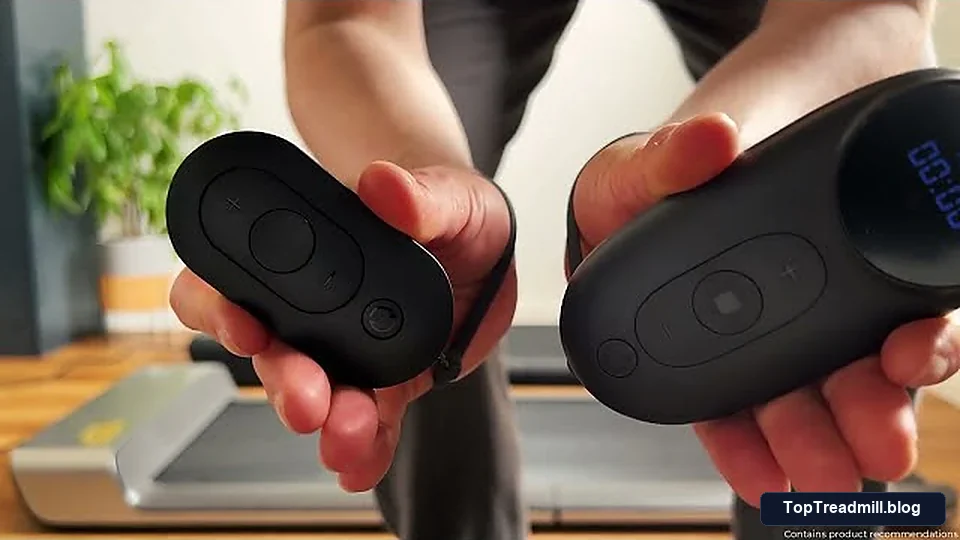
Control methodologies differ significantly between these two popular models. While one leans heavily into automation, the other relies exclusively on manual input devices for speed adjustments.
Operational feedback is delivered through a minimalist LED panel embedded directly beneath the walking belt surface. This hidden display clearly communicates elapsed time, distance traveled, and current speed metrics.
Handheld remote controls provide manual adjustments alongside smartphone app connectivity via Bluetooth. Users can toggle between automatic pace sensing and fixed manual mode to match their exact workout preferences.
- Embedded LED indicators display real-time workout metrics clearly.
- Minimalist bezels maintain a sleek, modern office appearance.
- Clear feedback helps users track daily step goals accurately.
Automated Speed Adjustments & Manual Modes
The A1 stands out by including foot-sensing technology that alters belt speed based on your positioning. Moving toward the front accelerates the belt, while stepping backward decelerates the unit automatically.
Conversely, the P1 omits this adaptive feature, requiring manual speed changes via the included wrist remote. Many traditional walkers prefer this tactile control method for predictable pacing.
- Foot-sensing zones on the A1 automate speed transitions.
- Wrist remotes provide reliable manual speed adjustments for the P1.
Maintenance, Efficiency & Longevity
Long-term ownership costs depend heavily on routine upkeep and electrical efficiency. Regular belt lubrication prevents premature friction wear, ensuring your motor operates within safe thermal limits over years of use.
Electrical draw remains minimal across both platforms during standard walking speeds. This efficiency makes them cost-effective additions to remote work setups without spiking monthly utility bills.
Regular belt lubrication is essential for reducing friction between the walking deck and running surface. Applying silicone oil every few months ensures optimal motor efficiency and prevents premature component wear.
Belt tension bolts located at the rear end allow precise alignment adjustments if the running surface drifts sideways. Proper tension maintenance directly extends the overall operational lifespan of the drive system.
- Silicone oil lubrication keeps walking belts tracking smoothly.
- Low power consumption supports continuous daily office use.
- Routine belt tensioning prevents slipping underfoot.
Belt Lubrication & Electrical Draw
Applying silicone lubricant to the running deck every few months is mandatory. Neglecting this simple maintenance task strains the motor and can trigger internal error codes.
Power consumption scales linearly with user weight and selected speed settings. Both models draw minimal amperage, allowing safe connection to standard household electrical circuits.
- Periodic lubrication protects internal drive components from wear.
- Standard wall outlets supply sufficient operating current.
Noise Emissions & Acoustic Profiles
Acoustic performance is critical when operating fitness gear in shared workspaces. Motor hum and footfalls generate vibrations that can disrupt conference calls if not properly dampened by design.
Both walking pads perform admirably well in keeping decibel levels low during casual use. Placing an equipment mat underneath further absorbs high-frequency vibrations transferred through hard flooring.
Acoustic output remains remarkably low due to the enclosed brushless motor design and dampening cushion layers. Operating noise typically hovers around decibel levels that easily allow conversation or phone calls.
Floor vibrations are effectively isolated by dense rubber feet attached to the bottom frame assembly. This prevents unwanted structural resonance from disturbing neighbors in multi-story residential apartment buildings.
- Low decibel output prevents distractions during phone calls.
- Rubberized feet isolate internal motor vibrations effectively.
- Floor mats reduce structural noise transmission in apartments.
Decibel Levels Under Normal Walking Loads
Measuring noise output reveals minor differences driven by motor housing construction. The A1 maintains a slightly softer acoustic profile thanks to its brushless motor design.
The P1 produces a faint mechanical whirring sound during higher speed intervals. Neither machine generates enough noise to interfere with normal speech or background music.
- Brushless motors reduce high-pitched whirring noises.
- Footfall sounds remain the primary acoustic factor.
Which Option Fits Your Setup
Choosing the right walking pad depends on your budget and preference for automation. Evaluate your daily workspace habits to determine whether hands-free speed control justifies your investment.
If you prefer straightforward manual controls and a simpler internal layout, the alternative choice delivers identical physical benefits. Prioritize the features that align with your daily workflow.
Selecting between these two walking pads depends primarily on aesthetic preferences and minor frame updates rather than massive performance gaps. Both units deliver reliable indoor stepping for busy professionals.
Evaluate your available storage space and integration requirements before making a final purchasing decision. Prioritizing correct mechanical upkeep will ensure years of dependable service from your chosen fitness equipment.
- Assess whether adaptive speed sensing fits your working style.
- Consider storage space constraints in your home office.
- Factor in long-term maintenance preferences before purchasing.
Ideal User Profiles & Office Integration
Active professionals who frequently change typing speeds benefit greatly from the A1. Its adaptive pacing removes the distraction of reaching for a remote control while working.
Conversely, users who maintain a steady, unchanging pace for hours find the P1 exceptionally reliable. Its simple remote operation provides uncomplicated control over every walking session.
- Adaptive users thrive with the automatic speed control of the A1.
- Steady-state walkers appreciate the simple P1 remote setup.
Frequently Asked Questions
Can I run on the Walkingpad A1 or P1?
Neither machine is designed for running. Both models cap out at six kilometers per hour, which strictly limits them to walking.
How does the automatic speed control work on the A1?
Pressure sensors embedded in the front deck detect your foot placement. Moving forward accelerates the belt while stepping backward slows you down.
Are these walking pads difficult to store away?
Not at all, because their patented folding hinges allow 180-degree compaction. You can easily slide them vertically against walls or under furniture.
What kind of maintenance do these treadmills require?
You must apply silicone lubricant beneath the walking belt periodically. This routine step prevents friction wear and protects the internal drive motor.
Do I need special electrical outlets to plug them in?
No special wiring is required for operation. Both walking pads plug directly into standard household outlets without tripping breakers.