Treadmill Walking vs Outdoor Walking Verdict
Compare the biomechanical impact and environmental differences of indoor treadmill sessions versus traditional outdoor walking. Choose the best method for your daily fitness routine.

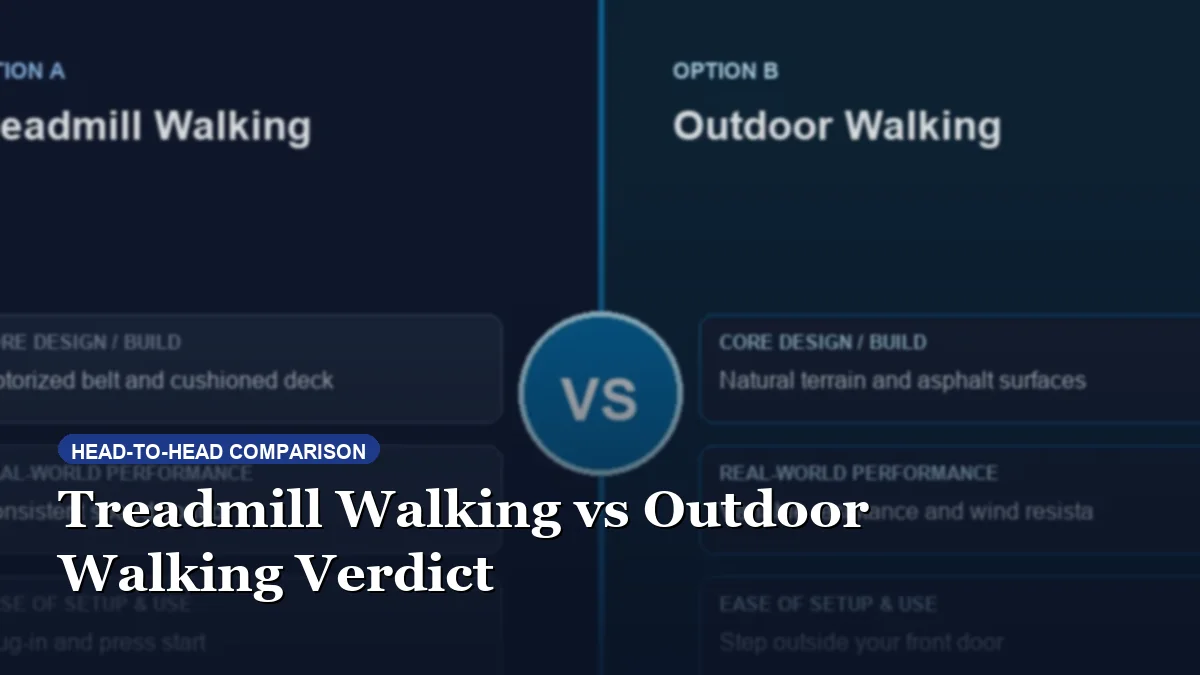
Choose treadmill walking for controlled cushioning and precise pace management during inclement weather. Select outdoor walking for natural terrain adaptation and zero equipment footprint.
Compare all top models in our Best Treadmill: Top Home Fitness Picks (2026 Guide).
Side-by-Side Breakdown
| Criteria | Treadmill Walking | Outdoor Walking | Edge |
|---|---|---|---|
| Core Design / Build | Motorized belt and cushioned deck | Natural terrain and asphalt surfaces | Treadmill Walking |
| Real-World Performance | Consistent speed control | Variable resistance and wind resistance | Outdoor Walking |
| Ease of Setup & Use | Plug-in and press start | Step outside your front door | Outdoor Walking |
| Durability & Reliability | Mechanical wear and belt friction | Weather exposure and joint impact | Tie |
| Efficiency / Operating Footprint | High electrical draw and floor space | Zero power consumption and portability | Outdoor Walking |
| Maintenance Requirements | Regular belt lubrication and deck cleaning | Shoe replacement and weather gear | Outdoor Walking |
| Best Ideal Use Case | Year-round home fitness and rehabilitation | Natural fresh air and cardiovascular variety | Split Decision |
Core Mechanical Design and Surface Engineering
Indoor motorized decks utilize a continuous poly-cotton belt running over a lubricated phenolic board. This engineered surface absorbs significant shock to protect your lower extremities from repetitive impact stress.

Outdoor pathways rely on concrete, asphalt, or packed dirt which offer zero shock absorption. Your musculoskeletal system must absorb every single pound of force without mechanical assistance from springs.
Indoor motorized treadmills utilize a continuous loop belt driven by a continuous horsepower motor, resting on a low-friction deck that incorporates elastomer cushions to absorb initial footstrike impact forces effectively.
Conversely, outdoor walking subjects joints to unyielding concrete, forcing your body to absorb higher shock loads. Many shoppers evaluate a dedicated walking treadmill for seniors to protect sensitive joints.
- Motorized rubber belts versus rigid asphalt terrain
- Synthetic cushioning elastomers versus natural ground reaction
- Stationary indoor placement versus dynamic outdoor route mapping
Belt Mechanics versus Natural Paths
Motorized belts pull your feet backward, subtly altering your natural stride frequency and leg extension. Outdoor walking requires you to actively propel your body mass forward across stationary ground.
- Passive belt propulsion versus active forward drive
- Consistent stride length constraints on indoor machines
Biomechanical Impact and Joint Loading Profiles
Treadmill decks often feature elastomer cushioning systems designed to reduce peak impact forces on your knees and ankles. Review treadmill walking pace conversions to bridge your indoor and outdoor workouts.
Unyielding outdoor surfaces force your connective tissues to manage higher impact spikes with every single step. However, this natural stress can stimulate greater bone density development over extended periods.
The synchronized movement of a motorized belt naturally encourages a shorter stride length and a higher cadence, reducing the anterior shear forces applied directly across your knee joints during extension.
Outdoor terrain introduces irregular inclines, loose gravel, and variable cambers, which actively engage your stabilizing ankle muscles and challenge your proprioceptive neuromuscular control far beyond standard indoor conditions.
- Reduced peak impact forces on indoor cushioned decks
- Higher ground reaction forces on concrete pavements
- Varying ankle stabilization demands across uneven outdoor trails
Assessing Joint Stress Levels
Choosing the right footwear becomes even more critical when walking outdoors on unforgiving concrete surfaces. Indoor walkers can occasionally prioritize lighter cushioning because the machine absorbs primary shock loads.
- Footwear impact absorption demands on outdoor concrete
- Lower extremity fatigue differences during extended sessions
Pace Regulation and Resistance Mechanics
Treadmills force you to maintain a strict, steady speed setting controlled by an electric motor. This automated pacing eliminates natural speed fluctuations common during unassisted human locomotion.
Outdoor walking introduces natural pacing variations influenced by fatigue, conversation, and changing topography. You must consciously monitor your cadence without any digital speedometer dictating your exact movement velocity.
Treadmills enforce a fixed belt speed, compelling your central nervous system to maintain a strict cadence, which eliminates natural pacing fluctuations but guarantees steady-state cardiovascular exertion metrics.
Walking outdoors requires you to generate all forward propulsion independently, overcoming both rolling resistance and aerodynamic drag, which typically results in a higher overall metabolic energy expenditure.
- Automated motor speeds enforcing strict cadence standards
- Natural self-selected pacing during unassisted outdoor excursions
- Digital incline adjustments versus natural hill climbing
Managing Incline and Wind Resistance
Walking outdoors exposes your body to aerodynamic drag from headwinds that increases caloric expenditure. Indoor walkers must manually engage a one-percent incline to mimic natural wind resistance.
- Headwind drag calculations during outdoor walking
- Manual incline simulation for indoor treadmill decks
Environmental Control and Weather Adaptation
Indoor walking provides a completely sheltered environment free from rain, snow, extreme heat, and dangerous UV rays. You can complete your daily step count comfortably regardless of outside weather conditions.
Outdoor walking connects you directly with natural sunlight, fresh air, and changing scenery that profoundly boost mental health. Sunlight exposure also triggers natural vitamin D synthesis during daytime sessions.
Indoor equipment provides complete climate isolation, allowing you to maintain consistent training schedules regardless of ambient temperature, humidity levels, or hazardous precipitation events occurring outside your facility.
Conversely, outdoor environments expose your respiratory system to fluctuating barometric pressures and thermal gradients, requiring careful clothing adjustments to prevent exercise-induced bronchoconstriction or heat stress issues.
- Climate-controlled indoor rooms versus unpredictable outdoor forecasts
- Visual stimulation from outdoor scenery versus staring at walls
- Protection from seasonal allergens versus fresh outdoor breezes
Psychological and Sensory Benefits
The visual monotony of walking indoors can sometimes lead to mental fatigue or decreased workout engagement. Outdoor environments offer rich sensory feedback that helps time pass much faster during exercise.
- Sensory engagement levels across different environments
- Mental fatigue mitigation through changing outdoor scenery
Maintenance Protocols and Long-Term Durability
Motorized equipment requires routine maintenance, including silicone belt lubrication and regular motor cleaning to prevent premature burnout. Ignoring these vital upkeep tasks can permanently damage your walking machine.
Outdoor walking requires virtually zero mechanical maintenance beyond replacing worn athletic shoes and seasonal clothing. Mother Nature handles the running surface upkeep while you focus purely on your physical fitness.
Motorized fitness machinery demands routine preventive maintenance, including weekly belt alignment checks, monthly silicone lubrication applications, and frequent vacuuming of accumulated dust beneath the motor compartment shroud.
Maintaining outdoor walking routes requires virtually zero mechanical upkeep for the user, though you must regularly inspect your footwear tread wear to prevent premature structural breakdown in your arch support.
- Routine silicone lubrication for internal belt systems
- Zero mechanical upkeep required for public sidewalks
- Periodic tension adjustments for motorized walking decks
Equipment Longevity and Wear
High-end walking pads and treadmills can last for thousands of miles if properly maintained with manufacturer-approved supplies. Conversely, your running shoes will degrade at similar rates in both environments.
- Expected lifespan of motorized treadmill components
- Footwear wear rates across indoor and outdoor surfaces
Spatial Footprint and Energy Consumption
Treadmills demand permanent floor space inside your home unless you select a compact unit from our best walking pad treadmill options. These space-saving models also consume minimal grid electricity daily.
Stepping outside eliminates your home spatial footprint entirely and consumes zero electrical power from the grid. You simply open your front door and begin your walking routine without any setup.
Modern folding treadmills occupy substantial floor space in your home, often requiring dedicated clearance zones and drawing considerable electrical current from standard residential wall outlets during operation.
Step-based outdoor exercise has a zero baseline electrical footprint and requires no permanent real estate inside your living quarters, offering ultimate spatial efficiency for urban apartment dwellers.
- Dedicated home floor space for bulky motorized equipment
- Electrical power consumption during every indoor workout session
- Portable folding designs versus permanent room installations
Convenience and Accessibility
Accessibility favors outdoor walking because you require no expensive machinery or electrical outlets to get started. Dedicated home treadmills offer unmatched convenience when severe weather prevents outdoor exercise entirely.
- Immediate access without equipment or setup barriers
- All-weather home availability for busy schedules
Selecting Your Ideal Walking Modality
Selecting your primary walking modality depends heavily on your local climate, joint health needs, and available home space. Combining both approaches often yields the most balanced physical fitness regimen possible.
Evaluate your daily schedule to determine if you prefer the structured control of indoor machines or spontaneous outdoor adventures. Your personal comfort and safety should guide your final equipment choice.
Choosing between these options depends heavily on your specific joint health goals, local climate limitations, and whether you prefer controlled programmatic workouts or organic environmental exploration.
Many dedicated fitness enthusiasts successfully combine both modalities, utilizing indoor machines for strict interval training sessions while saving weekend recovery walks for scenic outdoor trails.
- Climate-driven decisions for year-round workout consistency
- Joint health considerations favoring cushioned indoor surfaces
- Lifestyle preferences balancing convenience with outdoor exploration
Building a Hybrid Routine
Integrating indoor treadmill sessions during rainy weeks and outdoor walks on sunny days maximizes routine flexibility. Review the best outdoor treadmill models if you prefer exercising in fresh air year-round.
- Combining indoor and outdoor workouts for maximum flexibility
- Maintaining step consistency across changing seasonal conditions
Frequently Asked Questions
Is treadmill walking easier than walking outside?
Treadmill walking is often considered easier because the moving belt assists your stride. It also eliminates natural wind resistance found outdoors.
Do you burn more calories walking outside or on a treadmill?
Calorie burn remains very similar between both walking styles. Walking outside often demands more energy due to wind resistance and uneven terrain.
Can treadmill walking damage your joints over time?
Treadmills actually reduce joint impact thanks to their built-in cushioning systems. They are much safer for individuals recovering from lower body injuries.
How do I mimic outdoor walking on a treadmill?
You can easily mimic outdoor walking conditions on your machine. Just set your treadmill to a one-percent incline to offset missing wind resistance.
Which option is better for year-round consistency?
Indoor treadmills offer superior consistency because they bypass inclement weather completely. You never have to skip a workout due to rain or snow.