Slat Belt Treadmill vs Traditional Belt Treadmill
Evaluating commercial slat belt designs against traditional continuous-loop rubber belts requires examining biomechanical feedback, engineering complexity, and long-term upkeep. Understanding these structural differences ensures you choose the right running surface for your specific training environment.

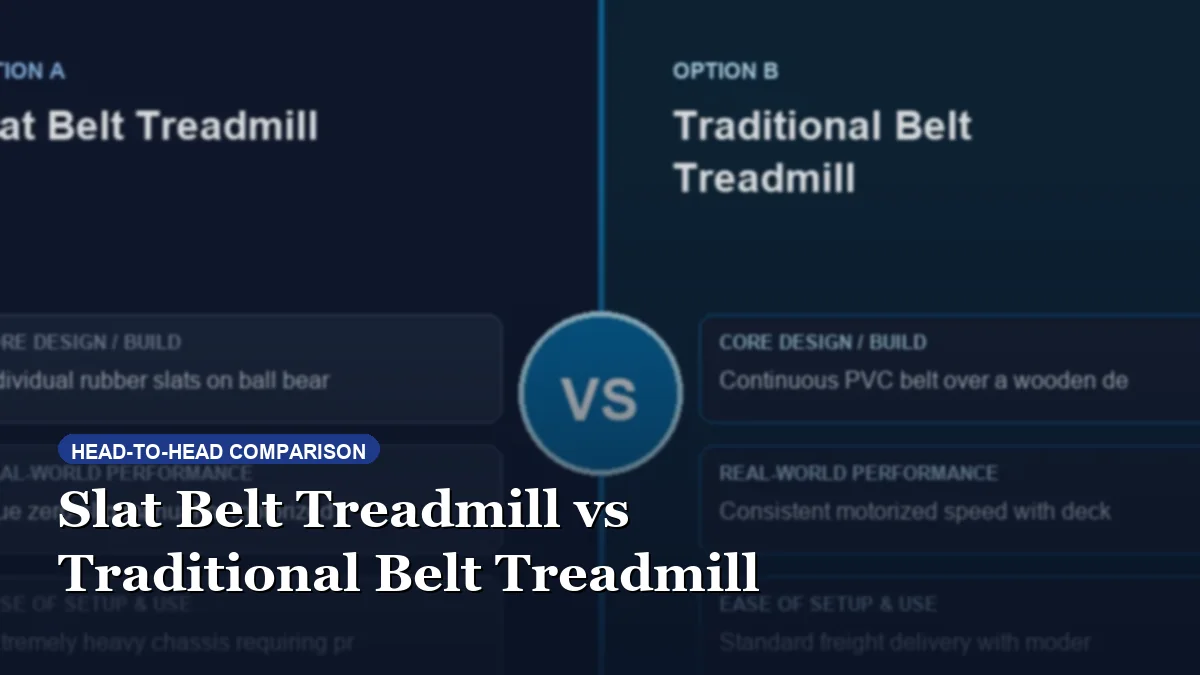
Choose the slat belt model if you want unmatched durability and authentic outdoor road mechanics for heavy sprinting. Opt for the traditional belt model if you prefer a quieter cushioned deck and lower initial equipment costs.
Compare all top models in our Best Treadmill: Top Home Fitness Picks (2026 Guide).
Side-by-Side Breakdown
| Criteria | Slat Belt Treadmill | Traditional Belt Treadmill | Edge |
|---|---|---|---|
| Core Design / Build | Individual rubber slats on ball bearings | Continuous PVC belt over a wooden deck | Slat Belt |
| Real-World Performance | True zero-slip manual or motorized resistance | Consistent motorized speed with deck friction | Slat Belt |
| Ease of Setup & Use | Extremely heavy chassis requiring professional rigging | Standard freight delivery with moderate assembly | Traditional Belt |
| Durability & Reliability | Engineered for 150,000+ miles of heavy use | Requires belt and deck replacements periodically | Slat Belt |
| Efficiency / Operating Footprint | Often unpowered or low-draw curved designs | Continuous electrical draw for heavy drive motors | Traditional Belt |
| Maintenance Requirements | Minimal lubrication due to ball-bearing slats | Frequent belt tensioning and silicone lubrication | Slat Belt |
| Best Ideal Use Case | High-volume commercial gyms and elite sprinting | Home fitness spaces and standard distance running | Tie |
Core Engineering and Structural Differences
Modern running machine architecture relies on two distinct philosophies regarding surface construction. Slat variants utilize segmented rubber slats mounted onto precision ball bearings, completely eliminating traditional friction decks.

Conversely, standard configurations feature a continuous synthetic loop stretched over a laminated fiberboard deck. Evaluating options highlighted in our best slat belt treadmills helps buyers balance ongoing upkeep against traditional upfront costs.
Slat belt systems utilize segmented rubber slats mounted on precision ball bearings, replacing traditional sliding friction surfaces with a rolling design that drastically reduces mechanical wear and internal friction resistance.
Traditional treadmills rely on a continuous-loop PVC belt gliding over a waxed phenolic deck, driven by a continuous duty motor that requires constant tension adjustment and regular deck lubrication.
- Segmented vulcanized rubber slats distribute impact force evenly.
- Continuous PVC belts require continuous tensioning to prevent slipping.
- Precision ball bearings replace standard low-friction sliding decks.
Surface Materials and Construction Quality
The physical composition of a running surface dictates its overall lifespan and tactile feedback. Slat variants incorporate heavy-duty polymer materials designed to withstand thousands of hours of aggressive cleated footwear use.
Traditional continuous belts utilize multi-ply woven fabrics coated in PVC or urethane. While adequate for standard athletic shoes, these materials degrade faster under high-friction sprinting conditions and lack extreme impact resilience.
- Multi-ply woven fabrics offer adequate grip for general jogging.
- Polymer slats resist tearing from specialized athletic footwear.
Biomechanical Impact and Running Dynamics
Footstrike mechanics change dramatically depending on the underlying hardware architecture. Slat models encourage a more natural midfoot or forefoot strike pattern because the independent slats absorb localized shear forces.
Traditional continuous surfaces provide a predictable motorized pull that assists stride turnover. However, this mechanical assistance can alter natural running economy compared to outdoor road running conditions.
The independent rubber slats on manual or motorized slat units naturally absorb high-frequency shock waves, resulting in lower impact forces transmitted through the ankles, knees, and lower lumbar spine.
Conventional running surfaces force your stride to match the pre-set speed of the motor, maintaining strict stride consistency while occasionally altering natural biomechanical propulsion patterns during longer workouts.
- Independent slats absorb horizontal shear stress efficiently.
- Motorized continuous belts force a specific cadence rhythm.
- Curved slat frames promote upright running posture during sprints.
Joint Stress and Shock Absorption
Mitigating repetitive impact forces remains critical for long-term runner health and injury prevention. Slat systems use flexible rubber blocks beneath each slat to dissipate shock before it reaches lower extremity joints.
Standard units rely on elastomer cushions placed strategically beneath the frame and deck. These dampening systems soften initial impact but degrade over time, altering the shock absorption profile unevenly.
- Flexible rubber blocks dissipate high-impact shock waves.
- Elastomer cushion mounts degrade with cumulative mileage.
Operational Efficiency and Power Consumption
Electrical demands vary significantly between these two popular fitness equipment categories. Many high-end slat systems operate entirely via user power, drawing zero electricity during intense manual sprint intervals.
Traditional models mandate continuous electrical current to power heavy-duty drive motors. Following our belt tension and calibration guide ensures these motorized units maintain precise belt speeds without escalating facility utility overhead.
Because many high-end slat designs rely on user-powered mechanics, they draw minimal electricity, utilizing self-generated resistance that only powers the electronic console display rather than driving the belt.
Traditional machines demand continuous electrical output from wall outlets, drawing high amperage spikes during acceleration phases to maintain steady motor torque against the friction of footstrikes.
- Manual slat designs eliminate motor power consumption entirely.
- Continuous-duty motors maintain stable speeds under heavy runners.
- Self-powered units reduce overall facility electrical infrastructure costs.
Motor Specifications and Torque Delivery
When motors are present in slat machines, they serve to assist heavy tracking rather than drive friction decks. This configuration reduces strain on electrical components and extends overall motor longevity.
Traditional units depend entirely on high-torque continuous horsepower motors to overcome deck friction. A failing motor drive controller on a standard machine immediately halts all workout functionality.
- Low-strain assist motors reduce electrical component burnout.
- High-torque continuous motors overcome sliding friction resistance.
Maintenance Schedules and Longevity Metrics
Facility managers prioritize equipment that minimizes downtime and reduces routine servicing overhead. Slat variations excel here by replacing sliding friction with rolling bearings that require virtually no daily attention.
Traditional setups demand consistent preventive maintenance protocols including monthly belt alignment checks. Neglecting this routine lubrication leads to premature motor burnout and expensive deck replacement procedures.
Slat systems eliminate belt alignment tasks entirely, shifting routine maintenance toward checking structural hardware and conducting periodic bearing inspections to ensure smooth rolling performance over decades.
Standard running platforms require frequent silicone lubrication applications beneath the walking surface, alongside proper execution of our belt tension guide to prevent premature deck wear and operational slippage.
- Rolling bearings minimize routine mechanical servicing needs.
- Monthly silicone lubrication prevents traditional belt wear.
- Component replacement intervals favor heavy-duty commercial slats.
Wear Patterns and Replacement Costs
Understanding component wear helps facility owners budget for long-term upkeep. Individual slats can be replaced independently if damaged, whereas traditional belts require complete replacement of the entire continuous loop.
The modular nature of segmented running surfaces ensures that maintenance remains localized. Traditional machines often require specialized technician labor to tension and center replacement running belts properly.
- Modular slat replacement avoids full-belt changeouts.
- Specialized technician labor is often required for traditional alignments.
Setup Complexity and Spatial Footprint
Physical dimensions and shipping weights dictate where heavy fitness apparatuses can be safely installed. Slat variants often exceed four hundred pounds, requiring professional installation teams and reinforced structural flooring.
Standard home units feature lighter frames and folding mechanisms that facilitate straightforward residential delivery. Their smaller physical footprints make them adaptable for spare bedrooms and multi-use workout spaces.
Engineering robust slat assemblies requires massive steel chassis frameworks, resulting in extremely heavy equipment that demands professional delivery and specialized floor placement because relocation is exceedingly difficult.
Traditional folding treadmills incorporate gas-shock hydraulic assist systems, allowing home users to pivot the running deck upward to reclaim valuable floor space using compact storage footprints.
- Heavy slat chassis require professional rigging and floor reinforcement.
- Lighter residential frames often include convenient folding storage options.
- Doorway clearance must be measured carefully before delivery.
Portability and Relocation Challenges
Moving heavy exercise equipment within a facility demands careful planning and proper leverage tools. Slat machines rarely feature transport wheels suited for tight residential hallways or carpeted stairs.
Traditional models typically incorporate front transport wheels and balanced weight distributions. This allows users to tilt and roll the apparatus into storage positions with minimal physical strain.
- Integrated transport wheels simplify standard unit relocation.
- Rigid commercial frames resist easy movement across facilities.
Acoustic Profiles and Vibration Dampening
Noise generation influences user satisfaction and multi-story building suitability significantly. Slat designs produce a distinct mechanical clatter during rapid footstrikes due to the segmented interlocking construction.
Traditional continuous belts operate with a quieter, low-frequency hum dominated by the drive motor. Proper vibration-dampening mats can easily isolate standard motor noise in shared residential housing complexes.
While slat belts avoid motor whines, the collective impact of multiple rubber slats creates a deep resonant thud requiring dense rubber mats to isolate structural vibrations.
Conventional machines produce steady mechanical noise from electric drive motors and cooling fans, generating distinct acoustic frequencies that contrast with quiet friction sounds from belt-deck contact.
- Segmented slats produce distinct mechanical clatter during use.
- Continuous motors emit steady low-frequency operational hums.
- Rubber isolation mats effectively reduce transmitted floor vibrations.
Sound Mitigation Strategies
Controlling acoustic output in commercial clubs or apartments requires targeted mitigation tactics. Placing heavy rubber interlocking tiles beneath a slat machine absorbs high-frequency impact sounds effectively.
Standard units benefit from regular belt tensioning to eliminate rhythmic slapping noises. Keeping drive pulleys clean prevents squeaking during high-speed interval training sessions.
- Interlocking rubber tiles absorb high-frequency impact sounds.
- Routine tension adjustments eliminate rhythmic belt slapping.
Financial Investment and Long-Term Value
Upfront capital expenditure remains a primary consideration for both home buyers and gym owners. Slat configurations represent a major financial commitment due to their complex manufacturing and heavy-duty engineering.
Traditional belt machines offer accessible entry points across a wide spectrum of budget tiers. This affordability makes continuous-belt technology the default choice for casual runners and home fitness enthusiasts.
Heavy commercial engineering gives slat systems exceptional structural durability, offering ultimate longevity under continuous athletic training environments without ever requiring frequent component replacements throughout their operating lifespan.
Standard belt units present an accessible entry point for home fitness buyers, though users should consult our drive belt replacement guide to understand future maintenance commitments for motorized drive components.
- Advanced engineering drives premium pricing for slat units.
- Diverse budget tiers make traditional belts widely accessible.
- Commercial longevity justifies higher upfront equipment investments.
Return on Investment for Facilities
Commercial gym operators must evaluate equipment durability against heavy membership usage rates. Investing in robust slat technology drastically reduces out-of-order downtime over years of continuous operation.
Budget-friendly traditional options may require more frequent replacement cycles in busy fitness centers. Balancing initial acquisition costs against projected service life determines true operational value.
- Robust commercial durability minimizes unexpected out-of-order downtime.
- Frequent replacement cycles impact long-term facility budgets.
Frequently Asked Questions
Why do slat belt treadmills cost significantly more than traditional ones?
Complex manufacturing processes and heavy-duty ball bearings drive up the initial production costs. These premium materials ensure exceptional longevity in commercial gym settings.
Do slat belt machines require regular lubrication like standard belts?
No, their rolling-element bearing design eliminates the need for frequent silicone lubrication. This drastically reduces ongoing maintenance requirements compared to continuous loops.
Can you run in running spikes or cleats on a slat belt?
Yes, vulcanized rubber slats withstand aggressive athletic footwear without tearing or degrading. Traditional PVC belts would suffer immediate surface damage under spikes.
Are traditional motorized treadmills better for steady-state endurance training?
Yes, continuous motor drives maintain a stable preset velocity without requiring constant user acceleration. This aids in maintaining precise pacing during long runs.
How much do commercial slat belt machines typically weigh?
Most commercial units exceed four hundred pounds due to their robust steel frames. Professional installation teams are usually required for safe placement.