Treadmill vs Pavement Running: Technical Comparison
Choosing between motorized belts and asphalt requires balancing biomechanical impact, climate control, and structural consistency. Your training goals dictate which surface optimizes recovery and performance metrics.

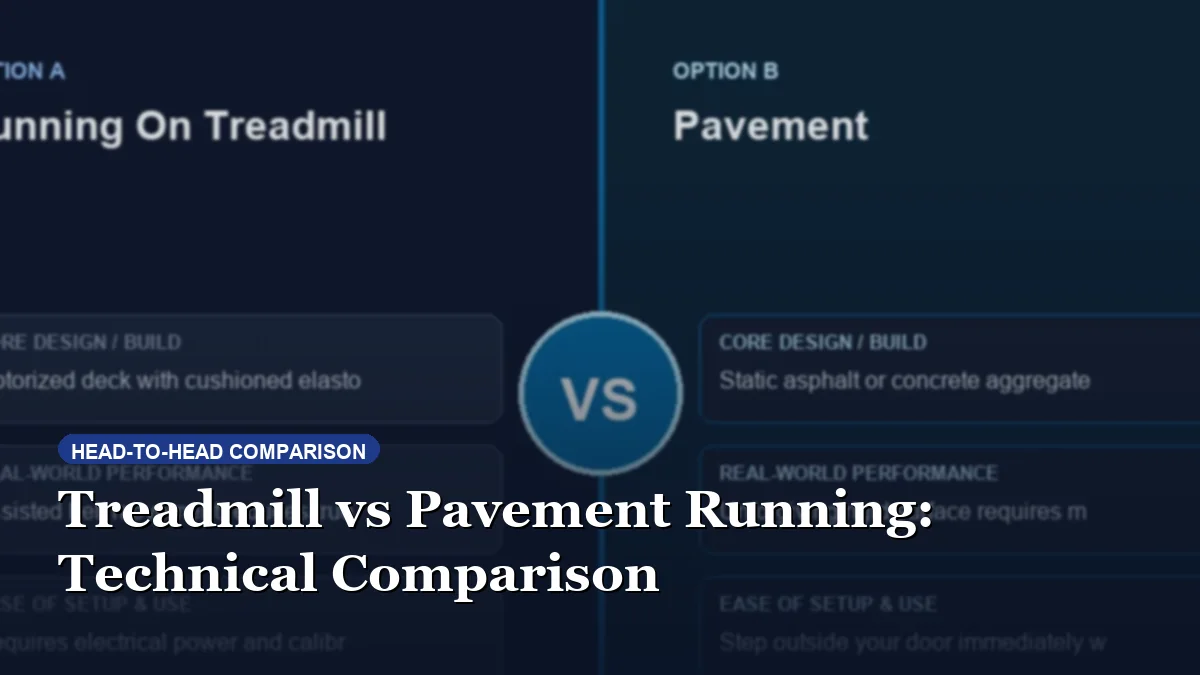
Choose motorized treadmills for controlled pacing and joint absorption, while outdoor pavement suits runners seeking natural propulsion and race-specific impact adaptation.
Compare all top models in our Best Treadmill: Top Home Fitness Picks (2026 Guide).
Side-by-Side Breakdown
| Criteria | Running On Treadmill | Pavement | Edge |
|---|---|---|---|
| Core Design / Build | Motorized deck with cushioned elastomer systems and moving belt. | Static asphalt or concrete aggregate with zero built-in compliance. | Running On Treadmill |
| Real-World Performance | Assisted belt movement reduces true propulsive force demands. | Unforgiving rigid surface requires maximum independent muscle engagement. | Pavement |
| Ease of Setup & Use | Requires electrical power and calibration before every running session. | Step outside your door immediately with zero equipment preparation required. | Pavement |
| Durability & Reliability | Mechanical parts, motors, and belts wear out over thousands of miles. | Geological foundation lasts indefinitely with occasional municipal asphalt resurfacing. | Pavement |
| Efficiency / Operating Footprint | Consumes electrical power and requires dedicated indoor room space. | Completely energy-free with infinite outdoor geographic operating space available. | Pavement |
| Maintenance Requirements | Regular belt lubrication, deck waxing, and dust vacuuming are mandatory. | No routine maintenance required by the individual runner whatsoever. | Pavement |
| Best Ideal Use Case | Interval training, rehabilitation periods, and severe weather avoidance. | Marathon preparation, race simulation, and outdoor spatial adaptation. | Split |
Biomechanical Impact and Joint Stress
Motorized belts absorb significant vertical shock through elastomer cushioning systems, drastically reducing the immediate ground reaction forces transmitted through your ankles, knees, and lower lumbar region during high-intensity training sessions.
Outdoor asphalt lacks any engineered shock absorption properties, meaning your musculoskeletal system absorbs the entirety of every footstrike impact without mechanical assistance from deck dampeners.
Running on hard asphalt generates rigid ground reaction forces. Choosing the best home treadmill for running introduces elastomeric deck cushioning to absorb these high-impact shocks before they reach your tibia.
Conversely, motorized treadmill decks utilize elastomeric cushions to attenuate vertical load vectors. This engineered deflection reduces peak tibial acceleration by up to fifteen percent, lowering cumulative microtrauma risks during high-mileage training blocks.
- Treadmills reduce peak impact forces by up to twenty percent.
- Pavement forces joints to manage unmitigated landing loads.
- Cushioned decks lower immediate post-run muscle soreness.
Evaluating Shock Absorption Dynamics
Deck suspension creates a slight trampoline effect that alters your natural stride mechanics while simultaneously protecting vulnerable connective tissues from repetitive stress injuries during high mileage weeks.
Rigid concrete pathways demand superior neuromuscular coordination and robust stabilizer strength to safely tolerate the constant, unyielding feedback delivered with every single stride.
- Suspension decks alter natural ankle dorsiflexion angles.
- Unforgiving outdoor surfaces build long-term bone density.
Surface Compliance and Energy Return
The moving belt featured on the best budget treadmill for running actually assists with leg turnover, reducing the physiological demand for active hamstring propulsion compared to outdoor running.
Conquering outdoor routes requires you to generate one hundred percent of your forward momentum by forcefully driving your body weight across a completely stationary, resistant surface.
Outdoor concrete sidewalks provide zero surface deformation, ensuring that every joule of propulsive energy relies entirely on your active plantarflexion. Muscle-tendon units must generate maximum stiffness to maintain running economy.
Treadmill belts stretch over rollers and dampening elements, creating a trampoline effect that alters metabolic demand. While some energy is returned, excessive belt compliance can hinder your explosive toe-off mechanics.
- Treadmill belts pull feet backward to ease propulsion.
- Asphalt demands total independent muscular force production.
- Outdoor strides feature slightly different kinematic profiles.
Propulsion Mechanics and Muscle Activation
Running indoors often leads to slightly shortened stride lengths because the machine moves the running platform underneath your center of mass without requiring traditional push-off power.
Outdoor pavement forces your posterior chain muscles to work significantly harder, engaging glutes and calves more completely to propel your body mass across the fixed terrain.
- Indoor trainers decrease overall hamstring recruitment.
- Outdoor terrain enhances posterior chain muscle strength.
Climate Control and Environmental Factors
Indoor equipment allows you to bypass extreme weather events, maintaining consistent training schedules regardless of freezing winter temperatures, torrential rain, or oppressive summer heatwaves.
Exercising outside exposes your body to variable ambient temperatures, wind resistance, and humidity levels, requiring careful hydration management and specialized technical apparel adjustments.
Pavement running exposes athletes to ambient thermal loads and direct solar radiation. Selecting the best folding treadmill for running lets you train indoors while managing core body temperature through built-in workout cooling fans.
Indoor treadmill sessions lack natural convective airflow, causing rapid sweat accumulation and elevated cardiovascular drift. Utilizing powerful industrial fans is essential to replicate outdoor thermoregulatory strain during intense treadmill workouts.
- Treadmills offer completely temperature-controlled training environments.
- Pavement running introduces unpredictable wind resistance variables.
- Indoor setups eliminate dangerous seasonal weather hazards.
Thermoregulation and Aerobic Stress
Without natural outdoor airflow to assist sweat evaporation, indoor runners experience elevated core body temperatures and higher heart rates at identical running speeds.
Outdoor environments provide natural cooling breezes, though extreme thermal conditions can drastically increase cardiovascular strain and alter normal metabolic pacing metrics.
- Indoor spaces require fans for adequate cooling.
- Outdoor elements test true cardiovascular heat tolerance.
Pacing Accuracy and Incline Mechanics
Digital consoles provide absolute control over your exact speed metrics, allowing precise intervals and targeted recovery phases without guessing your current pace.
Outdoor runners must rely on GPS watches or manual course markers, which can fluctuate in accuracy due to tall buildings, heavy tree cover, and satellite signal interference.
Maintaining a strict cadence on pavement requires deep intrinsic focus and GPS watch monitoring. Treadmill motors enforce a constant belt speed, eliminating natural velocity fluctuations and forcing absolute neuromuscular rhythm consistency.
Outdoor routes feature rolling hills that demand constant biomechanical adjustments. Setting a one percent incline on motorized trainers successfully compensates for the missing aerodynamic drag encountered during outdoor running.
- Digital motors enforce strict, unwavering speed discipline.
- Outdoor routes require mastery of self-regulated pacing.
- Incline adjustments simulate hill climbs with precise grades.
Calibrating Resistance and Elevation
Most modern motorized machines feature programmable elevation changes that accurately simulate uphill climbs and downhill descents to prepare your leg muscles for specific race profiles.
Navigating outdoor topology introduces natural undulating hills, uneven cambered roads, and unexpected potholes that test dynamic ankle stability and mental focus.
- Treadmill grades provide mathematically exact incline percentages.
- Outdoor routes feature complex multi-directional slope variations.
Safety Standards and Injury Risks
Indoor running eliminates the primary hazards associated with vehicular traffic, uneven sidewalks, aggressive stray animals, and poorly lit evening running routes.
Mechanical training carries unique risks, including potential missteps during high-speed belt activation, clothing snags, and the need for proper safety tether key placement.
Pavement introduces severe environmental hazards like uneven concrete slabs, hidden potholes, and vehicular traffic. These variables increase the incidence of acute ankle sprains and sudden traumatic slip-and-fall incidents.
Conversely, motorized equipment presents mechanical risks involving rapid belt friction and electrical failures. Using a safety magnetic tether is mandatory to prevent dangerous ejections during high-velocity treadmill missteps.
- Treadmills protect users from motor vehicle collisions.
- Outdoor paths present tripping hazards like cracked pavement.
- Safety tethers are essential for preventing dangerous machine falls.
Mitigating Unique Environmental Hazards
Maintaining spatial awareness is entirely unnecessary indoors, letting you focus fully on breathing rhythms, music, or video entertainment during lengthy endurance runs.
Outdoor athletes must remain constantly vigilant regarding surrounding traffic, changing light conditions, and slippery wet leaves or black ice during autumn and winter.
- Indoor units isolate runners from urban traffic dangers.
- Outdoor training demands high-visibility gear in low light.
Equipment Maintenance and Operational Costs
Owning a motorized machine requires ongoing mechanical upkeep, including periodic belt lubrication, motor vacuuming, electrical circuit checks, and eventual replacement of worn running decks.
Stepping outside onto public infrastructure costs nothing beyond proper footwear, bypassing all utility bills, replacement parts budgets, and bulky indoor equipment storage concerns.
Running outdoors incurs zero direct infrastructure maintenance fees beyond standard footwear replacements. Your running shoes absorb all abrasive friction against coarse asphalt, degrading outsole rubber after five hundred miles.
Treadmills require rigorous upkeep, including monthly silicone lubrication and electrical inspections. Neglecting deck friction parameters can overheat the drive motor and prematurely ruin expensive internal drive components.
- Treadmills demand regular silicone lubrication maintenance.
- Asphalt infrastructure requires zero personal upkeep expenses.
- Indoor machines take up substantial room floor space.
Long-Term Durability and Upkeep
High-end motorized units feature robust commercial-grade components designed to endure thousands of operating miles before requiring professional technician servicing or major part replacements.
Your running shoes represent your only primary equipment investment when pounding the pavement, though footwear foam midsoles degrade rapidly under heavy weekly mileage.
- Quality motors last many years with proper care.
- Shoe cushioning wears down equally fast on both surfaces.
Training Specificity and Race Preparation
Relying exclusively on indoor motorized tracks can leave runners unprepared for the psychological and physical demands of racing outdoors on hard, unyielding asphalt courses.
Balancing both training modalities ensures optimal aerobic development, reduced overuse injury rates, and complete preparedness for race day environmental conditions and terrain profiles.
Specificity dictates that race preparation should mimic actual course topography and environmental conditions. Relying exclusively on motorized belts may leave your stabilizer muscles unprepared for sharp cornering maneuvers found on race day.
Strategic cross-training combining both surfaces maximizes physiological adaptations. Utilizing treadmills for controlled tempo runs while saving long endurance sessions for pavement builds optimal muscular endurance without excessive joint breakdown.
- Exclusive indoor training misses outdoor wind resistance factors.
- Combining both methods yields well-rounded running fitness.
- Race simulation requires outdoor practice on actual courses.
Optimizing Your Hybrid Running Schedule
Choosing the best treadmill for long distance running for controlled indoor intervals while saving weekend mileage for outdoor pavement creates a balanced, highly effective training routine.
Strategic surface diversification conditions different muscle fiber groups, minimizes repetitive stress injuries, and keeps your mental engagement high throughout grueling marathon training cycles.
- Split weekly mileage between indoor and outdoor runs.
- Use treadmills for controlled speed work sessions.
Frequently Asked Questions
Does running on a treadmill burn fewer calories than running outside?
Treadmills can burn slightly fewer calories because the moving belt assists your forward propulsion and eliminates outdoor wind resistance. However, you can easily compensate for this minor difference by setting a one percent incline on your machine.
Why do my calves feel much tighter after switching to outdoor pavement?
Outdoor pavement lacks the shock-absorbing flex found in cushioned treadmill decks, forcing your calf muscles and Achilles tendons to absorb higher impact loads. This unyielding surface resistance dramatically increases eccentric muscle activation during every single footstrike.
Can running indoors cause knee pain due to unnatural stride mechanics?
Motorized running belts can occasionally alter your natural stride length because the moving surface pulls your feet backward automatically. This slight kinematic shift may stress your patellar tendons differently than running across standard outdoor asphalt.
How can I make indoor treadmill training feel more like running outside?
Setting your motorized deck to a one percent incline effectively mimics the natural aerodynamic drag experienced outdoors. Additionally, varying your speeds and avoiding excessive handrail holding will keep your muscle recruitment patterns authentic.
Is it safe to run exclusively on indoor machines year-round?
Running indoors exclusively is completely safe and protects your joints from harsh impact, provided you vary your inclines and speeds. However, transitioning outdoors occasionally remains crucial for building race-specific mental toughness and navigating terrain.