NordicTrack X22i vs Peloton Tread Comparison
Choosing between these elite cardio machines demands understanding incline limits and studio ecosystems. Your training goals dictate the ultimate winner.

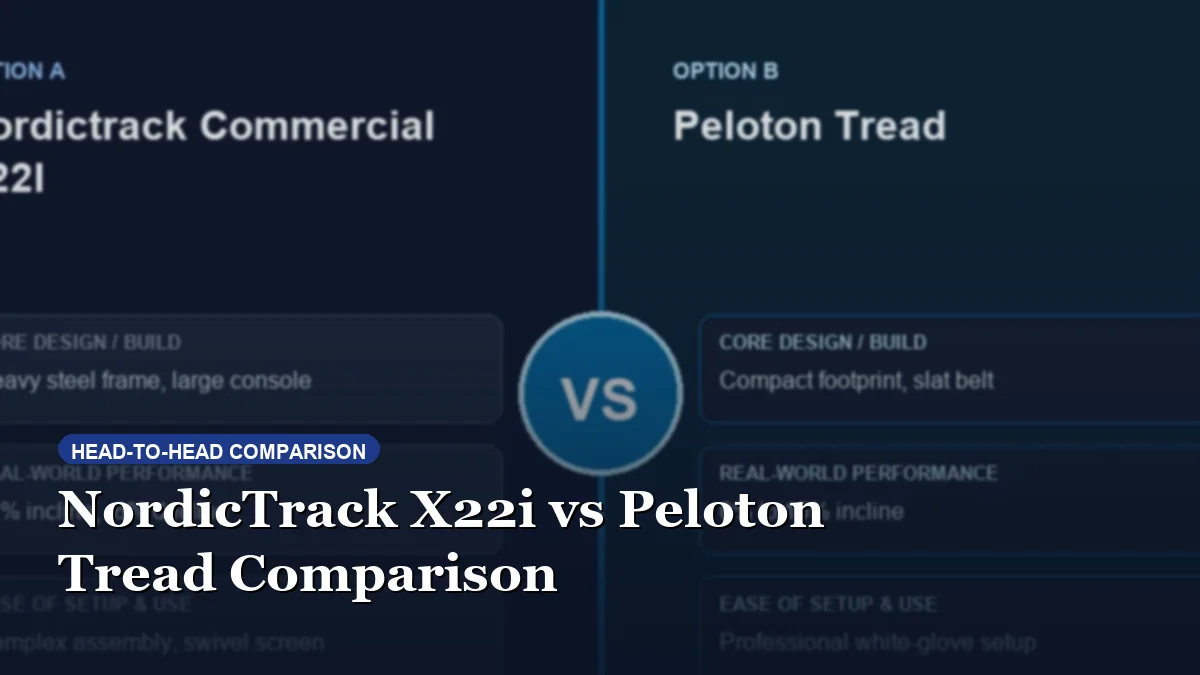
Choose the NordicTrack X22i for steep hill training and outdoor simulations, or select the Peloton Tread for high-energy studio classes and fast speed adjustments.
Compare all top models in our Best Treadmill: Top Home Fitness Picks (2026 Guide).
Side-by-Side Breakdown
| Criteria | Nordictrack Commercial X22I | Peloton Tread | Edge |
|---|---|---|---|
| Core Design / Build | Heavy steel frame, large console | Compact footprint, slat belt | Peloton Tread |
| Real-World Performance | 40% incline, -6% decline | 0% to 15% incline | Nordictrack Commercial X22I |
| Ease of Setup & Use | Complex assembly, swivel screen | Professional white-glove setup | Peloton Tread |
| Durability & Reliability | Commercial-grade lift motors | Commercial slat-belt mechanics | Peloton Tread |
| Efficiency / Operating Footprint | Large 22-inch display, high draw | Sleek profile, intuitive dials | Peloton Tread |
| Maintenance Requirements | Periodic belt lubrication | Minimal belt upkeep | Peloton Tread |
| Best Ideal Use Case | Outdoor trail simulation | Group fitness classes | Split Choice |
Architectural Design And Frame Construction
Evaluating structural integrity requires analyzing frame mass, steel gauge thickness, and overall footprint dimensions. The NordicTrack features a massive steel chassis designed to withstand extreme elevation changes without flexing under heavy footstrikes.

The welded steel chassis of the NordicTrack provides immense stability, whereas the Peloton Tread Plus review details a compact aluminum profile designed for smaller footprint integration in modern residential training spaces.
- Heavy-duty welded steel frame
- Wide footprint for stability
- Substantial machine weight
Peloton Frame Engineering
Peloton constructs its machine using high-grade carbon steel combined with an open, modern architectural footprint. This design prioritizes sleek aesthetics while maintaining exceptional rigidity during intense group running sessions and sprinting drills.
- Sleek structural profile
- Carbon steel construction
Incline Mechanics And Elevation Range
Hill simulation capabilities define the core operational difference between these two premium running platforms. As noted in our NordicTrack Commercial 2450 treadmill review, a proprietary incline motor reaches staggering mountain simulation angles.
Utilizing an industrial-grade actuator, the NordicTrack delivers an extreme minus six percent decline up to a forty percent incline, significantly outpacing the standard fifteen percent maximum elevation offered by the Peloton.
- Forty percent maximum incline
- Six percent decline capacity
- Rapid elevation transitions
Peloton Incline Approach
Peloton opts for a more traditional incline range geared toward road runners and interval enthusiasts. While it lacks extreme mountain gradients, the adjustment mechanism reacts instantly via convenient handlebar dials during live classes.
- Fifteen percent maximum incline
- Manual handlebar control dials
Console Interface And Digital Ecosystems
Software integration dictates how users experience workouts, track metrics, and consume entertainment content daily. The NordicTrack console features a massive high-definition screen designed to immerse runners in scenic iFit trails across the globe.
Operating on an Android-based touchscreen, the NordicTrack integrates seamlessly with iFit terrain simulations, while the Peloton relies on a locked proprietary interface optimized strictly for high-energy studio cycling and running classes.
- Twenty-two inch touchscreen
- Interactive trainer control
- Global outdoor workouts
Peloton Studio Experience
Peloton focuses heavily on instructor-led boutique fitness classes streamed live from high-end production studios. Their software emphasizes community leaderboards, energetic music synchronization, and a seamless user interface for fast metric tracking.
- Boutique studio classes
- Live competitive leaderboards
Drive Systems And Belt Engineering
Motor output and running belt construction govern overall mechanical efficiency, longevity, and perceived road feel. Our NordicTrack Commercial X22i review highlights its multi-ply belt driven by a powerful commercial motor engineered for heavy loads.
Driven by a high-torque commercial motor system, the NordicTrack handles sustained heavy loads effortlessly, matching the smooth acceleration of the Peloton’s precision-engineered slat-belt or traditional continuous loop running surface design.
- High horsepower motor
- Traditional friction belt
- Continuous cooling fans
Peloton Slat Belt Design
Peloton features an advanced individual slat belt system that mimics outdoor running surfaces with exceptional precision. This design reduces mechanical friction, distributes impact forces uniformly, and delivers an authentic road feel during intense sprints.
- Individual slat construction
- Low friction mechanics
Ergonomics And Deck Cushioning
Impact absorption protects joints during high-mileage training blocks while maintaining proper biomechanical running efficiency. NordicTrack includes an adjustable cushioning deck that lets users switch between firm road simulation and high shock absorption modes.
Runners seeking joint protection benefit from NordicTrack’s adjustable runners flex cushioning, whereas Peloton prioritizes a firm road-like feel through its rigid, low-profile deck architecture geared toward efficient biomechanical stride mechanics.
- Adjustable deck firmness
- Reduced joint impact
- Spacious running deck
Peloton Impact Management
Peloton relies on a specialized shock-absorbing slat deck designed to minimize repetitive stress injuries. The underlying engineering absorbs significant strike energy, ensuring comfortable pacing for runners of varying body weights and fitness levels.
- Slat impact absorption
- Consistent deck response
Maintenance Protocols And Long-Term Care
Protecting your equipment investment requires understanding routine upkeep and calibration checks. Our NordicTrack X22I review explains how regular belt lubrication maintains smooth operation under extreme incline angles and heavy loads.
Routine ownership tasks require regular silicone belt lubrication and tension checks on the NordicTrack, contrasted with the minimal upkeep demands of the Peloton’s sealed bearing and drive assembly components.
- Periodic belt lubrication
- Tension adjustments
- Dust removal care
Peloton Upkeep Simplicity
Peloton features a mechanical design that significantly reduces routine maintenance tasks for everyday home owners. The slat belt system eliminates traditional friction stretching concerns, demanding far less frequent alignment adjustments than standard running decks.
- Slat belt longevity
- Minimal deck alignment
Frequently Asked Questions
Which treadmill offers better hill training capabilities for serious endurance runners preparing for outdoor mountain races?
The NordicTrack machine provides vastly superior mountain simulation capabilities due to its truly unprecedented forty percent incline and negative six percent decline range during intense running sessions.
This incredible elevation span makes it the absolute undisputed champion for dedicated endurance athletes specifically training for steep outdoor trail events across exceptionally challenging and rugged mountainous terrain.
How do the user interfaces and digital subscription services differ between these two high-end running machines?
NordicTrack relies heavily on the immersive iFit software platform featuring gorgeous outdoor trail footage captured worldwide alongside automatic trainer elevation adjustments during guided personal workouts.
Conversely, Peloton focuses intently on high-energy boutique fitness studio classes featuring competitive live leaderboards, professional music curation, and rapid manual resistance control dials specifically built for intense indoor interval training sessions.
Which machine requires less ongoing maintenance and offers better long-term mechanical durability for heavy home use?
The Peloton model features an advanced individual slat belt design that significantly reduces mechanical friction and completely eliminates traditional belt tensioning chores over many years of heavy home usage.
Meanwhile, the NordicTrack machine requires routine periodic multi-ply belt lubrication, tension adjustments, and careful alignment checks to ensure consistently smooth operation under extremely heavy daily training loads.
How do the running deck shock absorption systems differ when comparing these two premium exercise machines?
NordicTrack incorporates a highly versatile and adjustable cushioning system that allows runners to seamlessly toggle between firm outdoor road simulation and high shock absorption modes for comfort.
Peloton utilizes a specialized multi-layer slat deck engineered to absorb heavy repetitive impact forces uniformly across varying running speeds for superior long-term joint protection during intense workouts.
Which treadmill model is better suited for users with limited space or specific room layout constraints?
The Peloton model offers a comparatively compact, streamlined, and modern physical footprint that integrates effortlessly into residential home gym layouts without visually overwhelming your designated living room space.
Meanwhile, the NordicTrack machine requires substantially more vertical and horizontal clearance space due to its massive console structure, heavy frame weight, and sweeping elevation range performance capabilities.