Incline Treadmill vs Flat Treadmill Technical Guide
Choosing between vertical grade capability and simple horizontal mechanics impacts mechanical wear, muscle recruitment, and footprint. Understanding core engineering differences ensures proper biomechanical alignment for long-term conditioning.

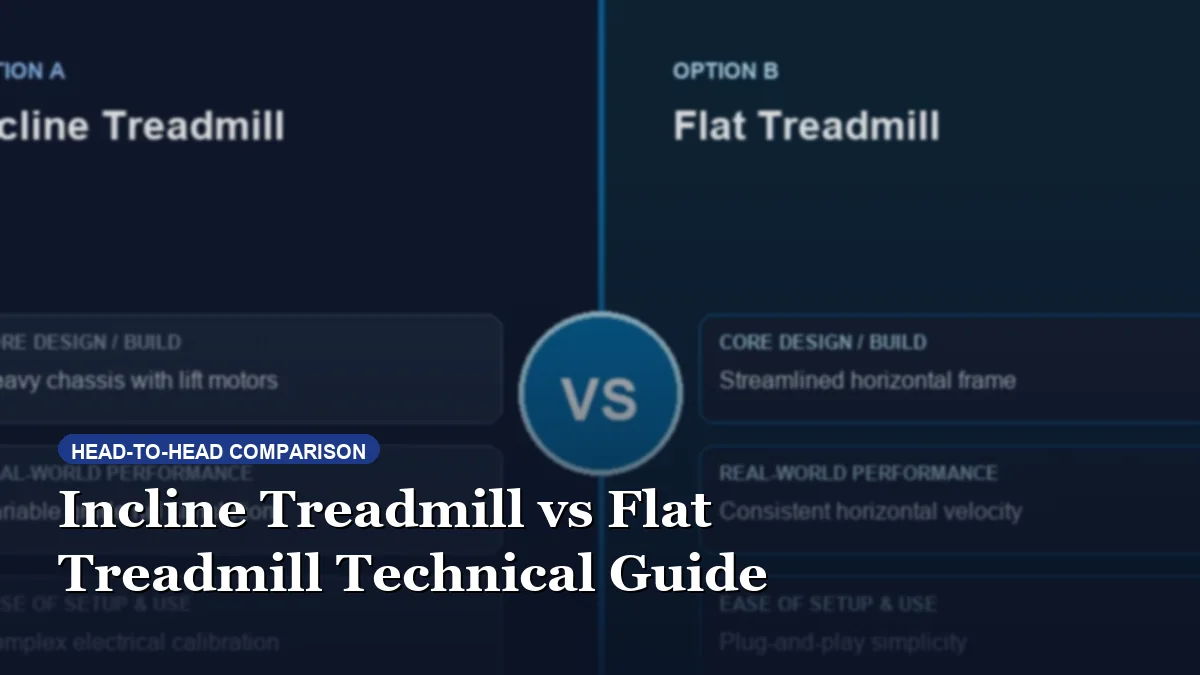
Pick Side A for intense caloric burn and hill simulation, or choose Side B for reliable walking pads and minimalist joint impact. Mechanical simplicity favors flat systems while elevation adds structural complexity.
Compare all top models in our Best Treadmill: Top Home Fitness Picks (2026 Guide).
Side-by-Side Breakdown
| Criteria | Incline Treadmill | Flat Treadmill | Edge |
|---|---|---|---|
| Core Design / Build | Heavy chassis with lift motors | Streamlined horizontal frame | Flat Treadmill |
| Real-World Performance | Variable grade hill simulation | Consistent horizontal velocity | Incline Treadmill |
| Ease of Setup & Use | Complex electrical calibration | Plug-and-play simplicity | Flat Treadmill |
| Durability & Reliability | More moving pivot points | Rigid single-piece decks | Flat Treadmill |
| Efficiency / Operating Footprint | Higher electrical draw | Low power consumption | Flat Treadmill |
| Maintenance Requirements | Requires lift screw grease | Basic belt alignment only | Flat Treadmill |
| Best Ideal Use Case | Advanced hill training | Low-impact daily walking | Incline Treadmill |
Core Engineering and Mechanical Differences
Selecting the right chassis architecture requires examining how frames handle dynamic loads. Incline systems integrate heavy-duty lift motors, whereas flat alternatives prioritize streamlined frames without vertical actuators.

Structural integrity dictates how well a treadmill absorbs high-impact strikes. Reviewing options in our best incline on treadmill for weight loss roundup reveals how reinforced pivot points handle compounding shear forces.
Incline models integrate a heavy-duty elevation motor alongside the primary drive system. This specialized actuator utilizes a high-torque lead screw to safely adjust the deck angle under full user load.
Conversely, standard flat platforms maintain a fixed horizontal plane. Their internal engineering focuses strictly on belt tracking and continuous horsepower output without managing the complex physical stress vectors of inclined elevation changes.
- Incline frames utilize heavy lift screws and robust pivot brackets.
- Flat platforms maintain a uniform chassis profile with minimal moving joints.
- Elevation mechanisms demand higher starting torque from secondary lift motors.
Motor Torque and Elevation Actuators
Elevation motors require substantial torque to raise a loaded deck safely. Continuous horsepower ratings must accommodate both the user weight and the added vertical resistance vector.
Flat treadmills bypass this complication by keeping the running surface permanently horizontal. This design reduces electronic failure points and simplifies internal wiring configurations significantly.
- Lift actuators add electrical complexity and potential wiring fatigue points.
- Flat drive systems focus entirely on belt velocity and roller rotation.
Biomechanical Loading and Muscle Activation
Walking or running at an angle fundamentally alters lower body kinematics. Glute and hamstring engagement increases dramatically when users elevate the deck past a five percent grade.
Flat surfaces promote a more traditional stride pattern with balanced quad recruitment. Users seeking lower joint impact often prefer this horizontal plane for steady recovery miles.
Raising the deck significantly alters your natural kinetic chain. Stepping onto an elevated surface increases gluteal engagement and forces greater ankle dorsiflexion, shifting mechanical demands away from the quadriceps toward posterior chain muscles.
Flat running surfaces maintain a horizontal joint trajectory. This configuration distributes impact forces more evenly across the knee joint and shin, reducing specialized muscular recruitment while mimicking traditional outdoor road running mechanics.
- Incline walking amplifies posterior chain muscle activation significantly.
- Flat running maintains neutral ankle and knee flexion angles.
- Elevation settings reduce stride length while increasing vertical displacement.
Posterior Chain versus Quad Dominance
Shifting the deck angle forces the ankles into greater dorsiflexion during foot strike. Calf muscle strain rises accordingly, building functional strength across the entire lower leg.
Conversely, flat treadmills distribute impact forces more evenly across the knee joint. This makes horizontal running a preferred choice for rehabilitating lower extremity injuries safely.
- Elevation targets calves, hamstrings, and glutes with high resistance.
- Flat surfaces protect sensitive patellar tendons from excessive shear stress.
Real-World Performance and Speed Calibration
When upgrading your routine, explore options in our best home treadmill with incline guide to find models featuring robust elevation motors and reliable velocity maintenance during steep hill workouts.
Elevation models often experience subtle belt hesitation when the incline motor engages. Maintaining consistent belt velocity requires sophisticated motor controllers with rapid response telemetry.
Incline training requires precise speed calibration to account for the altered stride length. As the deck tilts upward, your stride naturally shortens, demanding accurate tachometer readings from the motor controller to maintain consistency.
Flat treadmills deliver predictable velocity profiles across all belt speeds. Without the variable load of gravity fighting an uphill angle, speed sensors easily track rotations, ensuring true pace matching for interval and tempo workouts.
- Roller diameters influence belt grip and heat dissipation during long runs.
- Speed sensors must communicate accurately with elevation control boards.
- Flat treadmills deliver uninterrupted belt rotation without mechanical lag.
Belt Grip and Deck Stability
High incline settings push more body weight toward the front roller assembly. Multi-ply running belts prevent slipping and maintain reliable traction during aggressive climbing workouts.
Flat units distribute user weight evenly across the entire deck length. This uniform weight distribution reduces premature wear on front rollers and drive belts.
- Front-heavy weight distribution requires upgraded front roller bearings.
- Uniform deck loading extends overall component lifespan and reduces noise.
Maintenance Demands and Component Wear
Complex electromechanical systems naturally demand more routine service intervals. Lift screw lubrication prevents binding and ensures smooth transitions between different elevation grades.
Flat machines simplify routine upkeep by eliminating vulnerable vertical adjustment hardware. Owners only need to monitor belt tension, alignment, and silicone deck lubrication regularly.
Operating an incline mechanism introduces extra mechanical wear points. You must regularly lubricate the elevation pivot joints and inspect the drive screw threads to prevent binding and premature electrical motor burnout over time.
Standard flat units feature simpler maintenance schedules focused primarily on belt tensioning. Because they lack secondary lifting actuators, they experience fewer systemic mechanical failures, translating to lower long-term service and repair overhead overall.
- Incline actuators require periodic silicone grease application to prevent squeaking.
- Flat treadmills focus maintenance solely on belt centering and lubrication.
- Electrical connections endure less vibration fatigue on rigid flat frames.
Lubrication Intervals and Belt Tensioning
Friction management dictates the longevity of both the walking belt and motor board. Low-friction deck coatings reduce heat buildup during extended uphill hiking sessions.
Flat walking pads require precise tension adjustments to prevent lateral belt drift. Neglecting these minor adjustments can quickly damage the edges of the running belt.
- Silicone oil application frequency depends on weekly mileage usage.
- Belt tracking bolts need occasional calibration with an allen wrench.
Spatial Footprint and Storage Integration
Home gym layouts dictate strict spatial requirements for bulky cardio equipment. Checking our best treadmill incline for fat loss guide helps you identify space-efficient units featuring reliable hydraulic folding mechanisms.
Many flat walking pads feature ultra-low profiles designed to slide under furniture. These minimalist units prioritize compact storage over heavy-duty structural elevation capabilities.
Incline frames possess a substantially larger physical footprint. Their robust chassis and heavy-duty front housing require permanent floor placement, making vertical folding mechanisms complex and less structurally rigid during high-intensity running sessions.
Walking pads and flat compact platforms excel at spatial optimization. Their slim profiles slide easily beneath standard furniture, providing convenient storage solutions for urban apartments or dedicated multi-purpose home fitness rooms.
- Vertical storage designs reduce total floor footprint significantly.
- Low-profile flat pads slide easily beneath standard household beds.
- Incline frames generally require dedicated, permanent room placement.
Folding Frames versus Stationary Units
Upright folding locks secure the deck safely during non-use periods. Gas shock cylinders assist users by bearing the heavy lifting weight during fold-up procedures.
Stationary flat models offer maximum frame rigidity without folding hinge points. This rigid construction eliminates potential squeaks and wobbles during vigorous running strides.
- Hydraulic pistons prevent sudden accidental deck drops during unfolding.
- Rigid non-folding frames maximize maximum user weight capacity limits.
Energy Efficiency and Power Draw
Electrical consumption varies significantly based on internal motor specifications and workloads. Dual motor systems draw extra wattage when simultaneously driving the belt and raising the deck.
Flat treadmills operate efficiently using a single primary drive motor. This streamlined electrical demand lowers operating costs and reduces strain on standard household electrical circuits.
Operating an incline motor requires a continuous surge of electrical current. Drawing extra wattage to lift heavy loads against gravity increases your household power draw, making these units noticeably less energy efficient than flat models.
Flat walking pads operate with minimal electricity consumption. Their efficient direct-current motors maintain constant belt speeds with low electrical resistance, resulting in minimal power consumption during daily walking or light jogging routines.
- Incline adjustments temporarily spike electrical current draw during operation.
- Single-motor flat units maintain stable power consumption profiles consistently.
- Proper circuit grounding protects sensitive console electronics from power surges.
Continuous Horsepower Under Load
Sustained climbing demands higher continuous horsepower to prevent motor overheating. Cooling fan integration inside the motor housing ensures reliable performance during marathons.
Flat walking pads utilize smaller motors designed primarily for low-speed ambulation. Pushing these compact motors beyond their rated limits triggers thermal overload protection switches.
- Heavy-duty flywheels help smooth out motor torque delivery fluctuations.
- Thermal breakers protect internal wiring from catastrophic heat damage.
Selecting Your Ideal Platform
Determining the correct equipment depends heavily on specific cardiovascular objectives. Target heart rate zones are easier to reach quickly when incorporating steep hill simulations.
Walkers prioritizing low-impact daily movement find flat platforms exceptionally accommodating. Evaluating personal fitness goals ensures you invest in the most appropriate mechanical layout.
Choosing the right equipment depends on your goals, so consult our best incline treadmill to burn fat selections if you want hill simulation and enhanced posterior chain activation during workouts.
Evaluate your available floor space and maintenance willingness before purchasing. Balancing mechanical complexity against your training habits ensures you invest in reliable equipment that matches your long-term athletic and health requirements.
- Choose incline treadmills for advanced cardiovascular conditioning and hill training.
- Select flat treadmills for reliable daily walking and joint preservation.
- Assess available floor space before committing to heavy stationary frames.
Matching Equipment to Fitness Goals
Runners training for outdoor trail events benefit immensely from adjustable grades. Elevation training features prepare leg muscles for the rigors of real-world topography.
Office workers utilizing under-desk setups require quiet, flat walking surfaces. These minimalist machines integrate seamlessly into productive work environments without causing loud distractions.
- Hill simulations mimic outdoor running conditions for marathon runners.
- Quiet flat motors enable seamless multitasking during remote work hours.
Frequently Asked Questions
Do incline treadmills require significantly more maintenance than standard flat models?
Yes, incline systems integrate secondary lift motors and complex mechanical pivot points that demand regular lubrication and routine hardware inspections to function reliably in home environments.
Proper lift screw maintenance prevents premature mechanical binding and guarantees exceptionally smooth grade transitions over years of heavy physical conditioning.
Can flat treadmills provide an effective workout without elevation capabilities?
Flat treadmills deliver exceptional cardiovascular conditioning through sustained speed intervals and demanding steady-state distance running routines across various preset velocity levels.
Horizontal running mechanics reduce repetitive joint impact while still burning substantial calories during long endurance training sessions without requiring hill simulations.
Are incline treadmills safe for users recovering from lower body injuries?
Steep incline walking places intense shear stress on the Achilles tendons, knees, and calf muscles, which might aggravate delicate lower leg injuries during recovery.
Controlled flat walking remains a significantly safer choice for rehabilitation because it distributes impact forces evenly across joints.
How do power consumption rates differ between incline and flat machines?
Incline treadmills draw significantly higher electrical current when their secondary motors simultaneously drive the running belt and elevate the heavy steel deck. Dual motor systems increase overall energy consumption and generate more internal heat compared to streamlined flat alternatives.
Which option offers better long-term durability for intensive daily running?
Stationary flat treadmills often outlast elevation models because their rigid, non-folding frames eliminate vulnerable mechanical joints and hinge points. Simplified structural engineering ensures superior long-term reliability for dedicated athletes prioritizing high-mileage daily running routines.