Horizon 7.0 AT vs Sole F63: Technical Showdown
Navigating home cardio requires balancing motor response and frame durability. This technical guide contrasts two prominent mid-range treadmills.

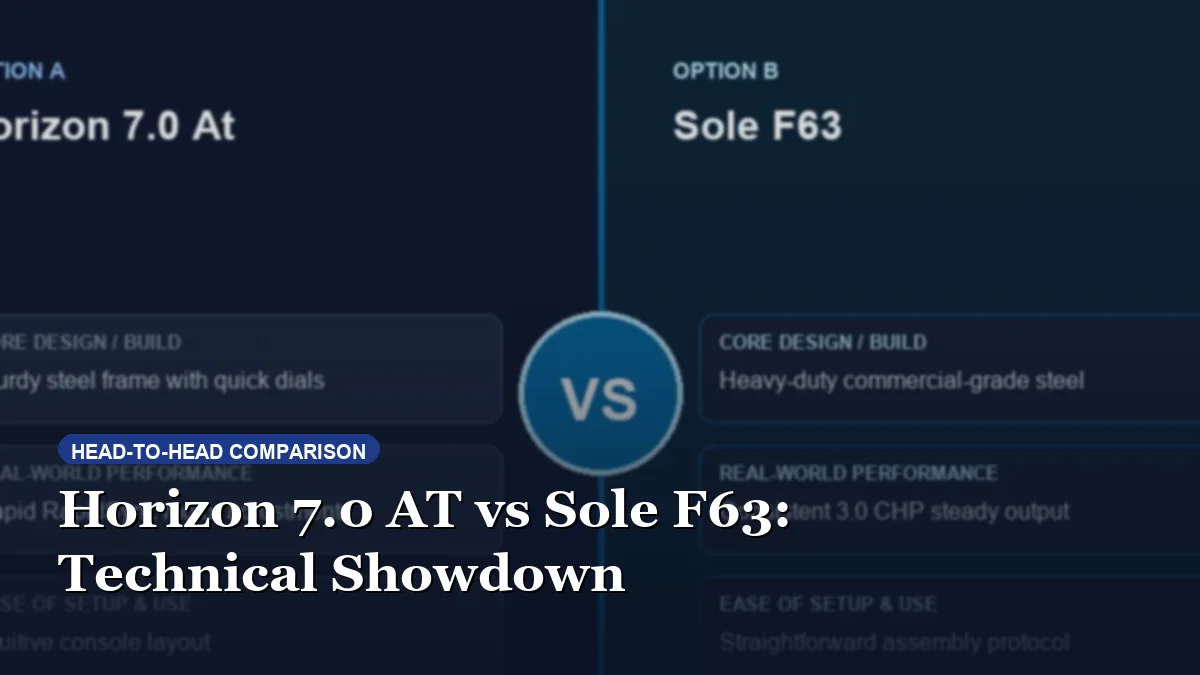
Choose the Horizon 7.0 AT for rapid interval responsiveness and third-party app streaming freedom. Select the Sole F63 for bulletproof frame stability and long-term mechanical reliability.
Compare all top models in our Best Treadmill: Top Home Fitness Picks (2026 Guide).
Side-by-Side Breakdown
| Criteria | Horizon 7.0 At | Sole F63 | Edge |
|---|---|---|---|
| Core Design / Build | Sturdy steel frame with quick dials | Heavy-duty commercial-grade steel | Sole F63 |
| Real-World Performance | Rapid RapidSync motor adjustments | Consistent 3.0 CHP steady output | Horizon 7.0 At |
| Ease of Setup & Use | Intuitive console layout | Straightforward assembly protocol | Horizon 7.0 At |
| Durability & Reliability | Solid lifetime frame warranty | Renowned for robust durability | Sole F63 |
| Efficiency / Operating Footprint | Standard folding mechanism | Folds with hydraulic lift assist | Sole F63 |
| Maintenance Requirements | Routine belt lubrication needed | Low maintenance phenolic deck | Tie |
| Best Ideal Use Case | Interval runners and app users | Walkers and steady-state joggers | Split |
Core Design and Engineering Differences
Engineering a mid-range treadmill demands compromises between structural mass and motor output. The Horizon 7.0 AT prioritizes dynamic response, featuring a lighter frame footprint built for swift speed and incline adjustments during intensive interval training sessions.
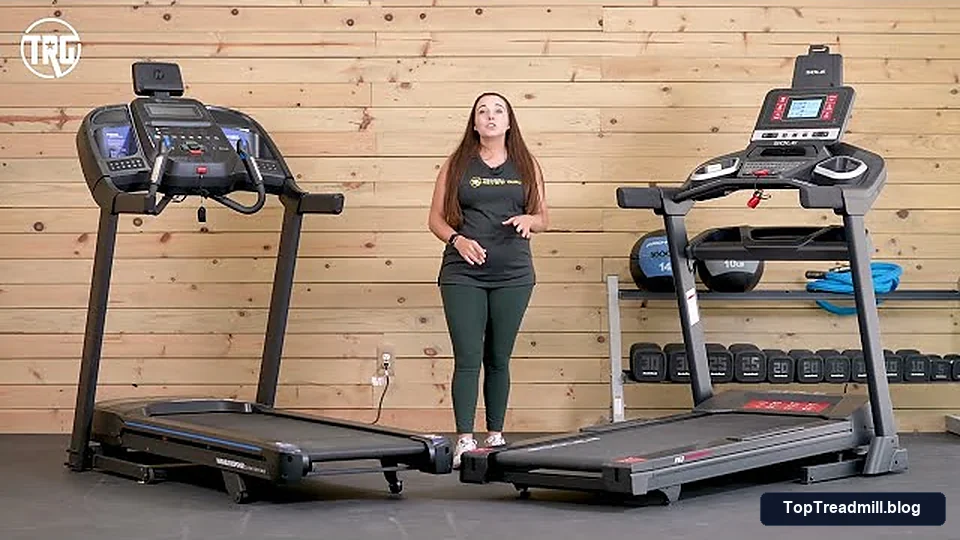
As highlighted in our Sole F63 consumer analysis, this model leans heavily toward gym-grade structural durability. Its massive steel uprights and reinforced crossbars reduce lateral vibration during long distance endurance training.
Examine the steel frame geometry of both models. The Horizon unit utilizes a lightweight folding mechanism, whereas the Sole platform prioritizes welded heavy-gauge steel for superior structural integrity during intense running sessions.
Roller dimensions also diverge significantly between these popular machines. Larger 2.5-inch tapered rollers on the Sole reduce belt tension and bearing wear, while Horizon relies on balanced small-diameter precision-machined alternatives for rapid speed response.
- Horizon utilizes a lighter frame optimized for quick residential relocation.
- Sole incorporates a reinforced steel chassis minimizing frame flex.
- Both models feature standard folding designs with hydraulic assist mechanisms.
Chassis Rigidity and Footprint
Frame engineering dictates how well a treadmill absorbs high impact forces. The Sole model delivers superior static stability due to its heavier overall weight and wider stance.
Meanwhile, the Horizon chassis trades some mass for agility, making it easier to maneuver across residential flooring while maintaining solid structural integrity under heavy daily use.
- Sole boasts a heavier gross weight for enhanced structural grounding.
- Horizon balances portability with strength for versatile home gym placements.
Real-World Performance and Motor Dynamics
Motor efficiency determines how smoothly a treadmill handles rapid pace transitions. The Horizon 7.0 AT employs a specialized drive system engineered to eliminate lag between console commands and belt speed changes.
As detailed in our Sole F63 treadmill review, this machine relies on a robust continuous horsepower motor designed for sustained torque and consistent belt rotation during long runs.
Continuous horsepower ratings dictate sustained output under heavy loads. Sole integrates a robust 3.0 CHP motor engineered to prevent overheating, contrasting with Horizon's rapid-response Rapid Sync motor designed for instant interval adjustments.
When transitioning between speeds, the internal pulse width modulation controllers react differently. The Sole manages heavier strides smoothly, whereas the Horizon excels at immediate pace shifts required during complex sprint workouts.
- Horizon features RapidSync technology for instant speed and incline shifts.
- Sole provides a high-torque motor tailored for steady state endurance running.
Speed and Incline Responsiveness
Interval runners demand zero delay when shifting between recovery paces and sprint velocities. Horizon excels here by utilizing a finely tuned controller board that reacts almost instantly.
Sole prioritizes gradual acceleration curves to protect internal electrical components from thermal overload during prolonged high intensity workouts.
- Interval training favors the rapid transitions of the Horizon unit.
- Endurance jogging benefits from the smooth acceleration of the Sole motor.
Deck Cushioning and Impact Mechanics
As noted in our Horizon T101 treadmill review, joint protection remains a primary concern for runners logging high weekly mileage. The platform integrates a variable cushioning system that adapts to your natural stride.
The Sole competitor utilizes a distinct flex cushion design engineered to absorb up to forty percent more impact than running on asphalt, reducing cumulative stress on knees and ankles.
Shock absorption technologies protect joints through distinct mechanical approaches. Horizon features a three-zone variable response cushioning system that offers firmer support at push-off, while Sole employs a Flex Whisper Deck design reducing impact forces.
Biomechanical testing reveals that runner footstrike deflection varies across these surfaces. Heavier runners often prefer the dampened elastomer mounts on the Sole, while sprinters appreciate the stable rear deck feel of the Horizon.
- Horizon uses a three-zone system targeting footstrike and push-off phases.
- Sole applies flex deck technology to absorb heavy repetitive impact shocks.
Biomechanics and Joint Protection
Running ergonomics depend heavily on deck firmness consistency. Horizon offers a firmer push-off zone paired with a softer impact zone for optimal biomechanical efficiency.
Sole maintains a uniformly cushioned surface that reduces fatigue across extended training sessions, though some runners prefer a firmer road-like feel.
- Variable cushioning on Horizon supports natural running stride dynamics.
- Uniform shock absorption on Sole protects joints during long distance jogs.
Console Technology and App Connectivity
Modern home fitness equipment requires seamless integration with training applications and personal devices. The Horizon 7.0 AT stands out by offering open Bluetooth connectivity for various third-party fitness platforms without locked subscription walls.
The Sole F63 provides a straightforward, highly legible LCD screen with built-in workout programs. It focuses on functional data delivery rather than immersive virtual worlds or complex interactive streaming.
As outlined in our Sole Fitness F80 review, digital interfaces cater to distinct user preferences. Sole incorporates a straightforward backlit LCD screen focusing exclusively on vital workout metrics.
Managing workout data requires robust hardware connectivity protocols. The Horizon console supports quick-dial controls for fast adjustments, whereas the Sole prioritizes an integrated tablet holder positioned securely above the primary display panel.
- Horizon delivers open Bluetooth pairing for flexible app usage.
- Sole focuses on straightforward data metrics without mandatory subscriptions.
Interface Usability and Controls
Quick-touch roller dials on the Horizon console allow runners to adjust speed and elevation instantly without breaking running form. This design simplifies mid-workout adjustments significantly.
Sole relies on traditional tactile buttons placed on both the console and handrails, offering reliable input feedback that users wearing running gloves can easily operate.
- Horizon features intuitive thumb dials for rapid pace changes.
- Sole incorporates tactile console buttons for reliable operation.
Maintenance, Efficiency, and Longevity
Long-term ownership costs depend on routine upkeep requirements and component durability. Both treadmills feature reversible decks and durable running belts that extend maintenance intervals under normal operating conditions.
Proper belt lubrication and dust removal remain essential for preserving motor controller longevity on both units, ensuring reliable performance across thousands of training miles.
Routine upkeep preserves mechanical integrity over thousands of miles. Sole utilizes a wax-infused running deck that extends lubrication intervals, contrasting with the standard silicone oil requirement specified for the Horizon multi-ply belt.
Electrical efficiency and standby power draw matter for home users. Both units incorporate power-saving sleep modes, but the heavy-duty components on the Sole require careful monitoring of dedicated circuit breakers during peak operation.
- Routine silicone lubrication is required every few months.
- Reversible decks double the service lifespan of the running surface.
- Regular vacuuming prevents dust accumulation inside the motor hood.
Electrical Efficiency and Upkeep
Energy consumption during standard operation is comparable between both motors when running at moderate user weights and typical training velocities.
Keeping the running belt properly tensioned prevents premature roller bearing wear and protects the internal electronics from excessive electrical draw.
- Proper belt tensioning prevents mechanical drag and overheating.
- Standard household outlets easily support the power requirements.
Safety Standards and Ergonomic Adjustments
Home fitness equipment must comply with rigorous safety protocols to prevent accidents during high-speed training. Both machines include standard magnetic safety keys and automatic shutoff features.
Ergonomic handrail positioning on the Sole F63 offers secure grip points for users requiring extra balance stability, while the Horizon unit keeps side rails streamlined.
Safety compliance ensures secure operation under emergency conditions. Each machine features a magnetic safety tether linked directly to an auto-stop circuit, alongside mandatory ASTM-certified emergency stop mechanisms for residential fitness environments.
Ergonomic layout dictates user comfort during extended endurance runs. Handrail controls on the Horizon provide convenient thumb switches, while Sole integrates wider heart-rate contact grips directly into the front console uprights.
- Magnetic safety tethers provide immediate emergency stoppage capabilities.
- Extended handrails on Sole assist walking safety and balance.
Safety Features and Stability
Emergency stop keys are mandatory for halting the running belt instantly if a user trips or loses footing during a fast interval sprint session.
Solid anchoring prevents the treadmill chassis from shifting during heavy incline workouts, protecting the user from awkward footfalls and joint strains.
- Quick-stop tethers ensure reliable user protection during sprints.
- Sturdy chassis design prevents undesirable rocking motions.
Which Option Fits Your Specific Setup
Choosing between these two exceptional treadmills ultimately depends on your specific training style and home gym environment requirements. Runners focusing on high-speed intervals will appreciate the Horizon design.
Conversely, walkers and steady-state joggers prioritizing maximum frame stability and straightforward mechanical longevity will find the Sole model perfectly suited to their daily routine.
Selecting the optimal treadmill depends heavily on your primary training goals. Interval runners benefit from the responsive drive system of the Horizon, whereas distance specialists prefer the durable frame construction offered by Sole.
Space constraints and user weight capacities further narrow your final purchasing decision. Review your available floor dimensions carefully, ensuring your chosen machine accommodates your specific maximum user weight requirements without structural compromise.
- Pick Horizon for interval training and flexible app connectivity.
- Choose Sole for heavy-duty stability and traditional reliability.
- Assess your available floor space before making a final selection.
Final Decision Matrix
Evaluate your primary fitness goals carefully before investing in residential cardio equipment. Matching machine capabilities to your workout habits ensures lasting satisfaction.
Both choices represent top-tier engineering within their respective market categories, delivering dependable performance for dedicated home fitness enthusiasts.
- Prioritize motor responsiveness for structured interval workouts.
- Focus on frame mass for heavy daily mileage.
Frequently Asked Questions
Which treadmill handles interval training better?
The Horizon 7.0 AT excels here due to its rapid speed and incline motor adjustments. These quick transitions eliminate frustrating lags during fast paced workout sessions.
Do both treadmills require subscription fees?
Neither machine forces mandatory ongoing subscriptions for basic operation. You can use their built-in programs freely or connect third-party apps via Bluetooth technology.
Which model offers better joint cushioning?
The Sole F63 provides a slightly softer impact-absorbing deck tailored for distance runners. Meanwhile, the Horizon uses a variable response system for different stride zones.
How difficult is the initial assembly process?
Both units require standard two-person assembly using included hardware tools. Following the manufacturer instruction manual ensures proper alignment and structural stability.
What maintenance do these running decks require?
Routine upkeep involves applying silicone lubricant to the belt and deck every few months. Keeping the motor compartment clean prevents dust buildup over time.